
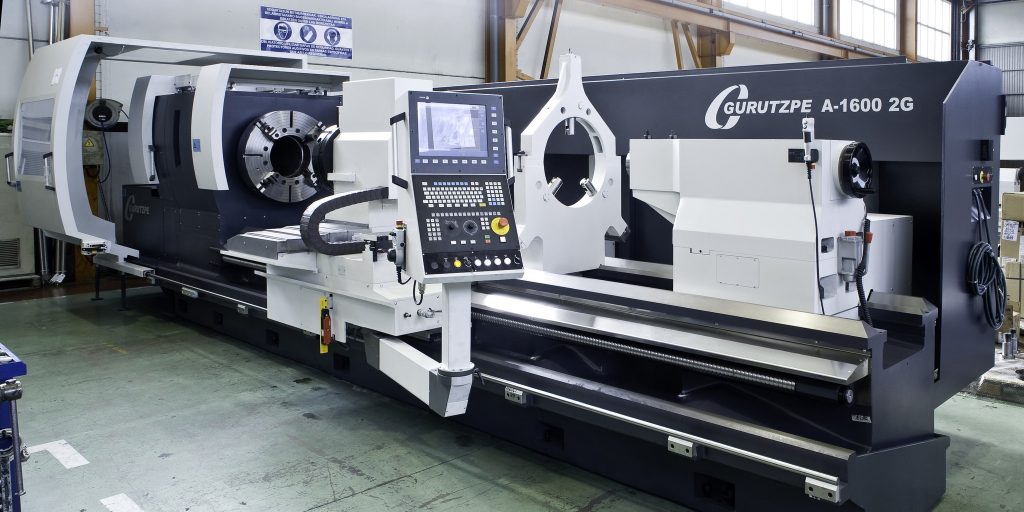
If you’ve ever looked at a car engine, an airplane part, or even a simple metal screw, you’ve seen the product of a CNC lathe machine. These incredible machines are the workhorses of modern manufacturing, capable of creating complex, cylindrical parts with mind-boggling precision. But what is a CNC lathe, and how does it perform its magic?
This guide will walk you through the basics of these powerful machines, from their core components to how they can transform raw materials into finished parts with a few lines of code.
What is a CNC Lathe?
A CNC lathe is a computer-controlled turning machine that shapes a workpiece by rotating it against a stationary cutting tool. The term “CNC” stands for Computer Numerical Control, which means the machine’s movements are guided by pre-programmed software rather than manual operation. Think of it as the digital evolution of a traditional lathe.
While an old-school machinist had to manually crank wheels and levers to control the cutting process, a modern CNC lathe follows a set of instructions, or G-code, with pinpoint accuracy. The result is unparalleled efficiency, precision, and repeatability, which is essential for industries that require thousands of identical parts.
Main Parts of a CNC Lathe
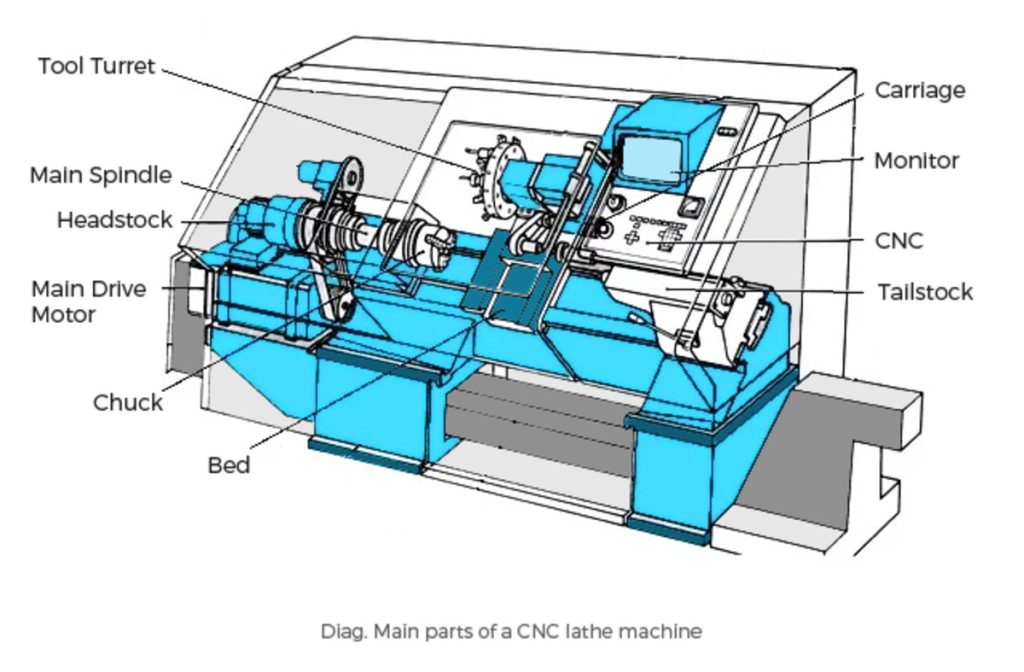
Understanding the main components is the key to understanding how these machines operate. Each part plays a crucial role in securing the material and executing the cutting program.
Chuck
The chuck is the component responsible for clamping and holding the workpiece securely in place. It's a key part of the headstock and uses jaws, often three or four of them, to grip the material so it can be precisely rotated at high speeds without slipping.
Tailstock
The tailstock is located on the opposite end of the machine from the chuck. Its job is to provide support for longer workpieces to prevent them from bending or vibrating during the turning process. It can also hold and feed tools for operations like drilling holes along the center axis of the part.
Tool Turret
The tool turret is the automated tool holder on a CNC lathe. It holds multiple cutting tools, anywhere from 8 to 24 or more, and can rotate to quickly position the correct tool in front of the workpiece. This automation is a major reason why CNC lathes can complete complex parts so quickly without manual intervention, saving both time and cost.
Headstock
The headstock is the power center of the lathe. It houses the main motor, spindle, and drive mechanism. It’s the part that controls the speed at which the workpiece rotates, a critical factor in achieving the right surface finish and preventing tool wear.
Spindle
The spindle is the rotating shaft inside the headstock. The chuck is mounted directly to the spindle, and its rotation provides the primary motion for the entire turning process. Modern CNC spindles can reach thousands of RPMs, enabling extremely fast cutting times.
Machine Bed & Carriage
The machine bed (carriage) is the foundational structure of the CNC lathe, a heavy and rigid base (often made of cast iron) that provides stability and absorbs vibrations. The carriage is mounted on the bed and moves the cutting tool along the length of the workpiece (the Z-axis), while the cross-slide on the carriage moves the tool in and out (the X-axis). These components are essential for precise movement.
CNC Control Panel
Often referred to as the brain of the machine, the CNC control panel is the operator’s interface. This is where the machining program is loaded and managed, allowing the operator to start and stop the process, make adjustments, and monitor the machine's status.
Coolant System
The coolant system is a crucial but often overlooked component. It continuously pumps a stream of liquid onto the cutting area to cool the workpiece and cutting tool, prevent thermal expansion, and wash away chips. This significantly extends the tool’s lifespan and helps maintain a high-quality surface finish.
Get an instant quote from Xmake by uploading your design file today, and enjoy fast, reliable delivery with our expert manufacturing services.
Start a QuoteCNC Lathe Machining Process
The CNC lathe machining process is a sophisticated dance of hardware and software that ensures every part is made exactly as designed. It's not just about pushing a button; it's a multi-step process that requires careful planning.
First, an engineer designs the part using computer-aided design (CAD) software. This creates a 3D digital model of the final component. The CAD file is then imported into computer-aided manufacturing (CAM) software, where a programmer defines the cutting path. They choose the specific cutting tools and set parameters like spindle speed, feed rate, and the precise sequence of operations.
This CAM software translates the plan into a set of instructions known as G-code and M-code.
- G-code (Geometrical Code): This is the language of movement. It tells the machine where to go, how fast, and what path to follow. For example, a command like G01 X1.0 Z-0.5 F10 tells the cutting tool to move linearly to a specific coordinate at a specific feed rate.
- M-code (Miscellaneous Code): These are the commands for machine functions. They control things like turning the spindle on/off, starting or stopping the coolant flow, or changing the tool in the turret.
Once the program is loaded, an operator sets up the raw material in the chuck and loads the required tools into the turret. Then, the machine takes over. The spindle spins the material at a high RPM, and the cutting tool moves precisely along the X and Z axes (side-to-side and back-and-forth).
The machine meticulously cuts away layers of material, following the programmed path, often using a constant stream of coolant to prevent overheating. The process continues automatically until the final, perfectly-shaped part is complete, with tolerances often as tight as 0.0005 inches.
Types of CNC Lathes
CNC lathes cover a wide range of machines, each designed for specific tasks. The type you choose depends on the material, size, and complexity of the parts you need to make.
Horizontal vs. Vertical Lathes
The most common type is the horizontal CNC lathe, where the workpiece is held horizontally. These are perfect for long, slender parts like shafts and axles. Vertical lathes, on the other hand, hold the workpiece vertically. This orientation is ideal for short, heavy, and large-diameter parts, as gravity helps with stability.
Functional Lathes
A standard CNC metal lathe is built for shaping tough materials like steel and aluminum, while a CNC wood lathe is optimized for softer materials and different tool geometries. For smaller operations, a mini CNC lathe or a small CNC lathe provides a compact and affordable entry point. These are often used for prototypes or hobby free CNC projects where space is limited.
CNC Lathes vs. Manual Lathes
While manual lathes still have their place, CNC technology has largely replaced them in modern manufacturing. The differences are night and day.
| Feature | CNC Lathe | Manual Lathe (Engine/Conventional Lathe) |
| Precision | Extremely high, up to ±0.0005" | Depends on operator skill, typically ±0.005" or looser |
| Speed | Very fast, consistent production | Slower, limited by the operator's speed |
| Consistency | Perfect repeatability across thousands of parts | Prone to human error, variations between parts |
| Complexity | Excellent for intricate geometries and threads | Limited to simple shapes and manual operations |
| Safety | High, operators are away from the cutting area | Lower, operators are in close proximity to the work |
| Setup Time | Longer initial (programming + fixturing), but fast for repeat jobs | Quick for simple/one-off jobs, but slower for changes or complex setups |
| Cost | Higher initial investment (machine + programming), lower long-term per-part cost | Lower initial cost, higher ongoing labor and per-part cost for volume |
| Ideal Applications | Medium to high-volume production, complex/precise parts, aerospace, automotive, medical | Low-volume, prototypes, custom/one-off parts, repairs, training, small shops |
The table above illustrates the key differences, but the real advantage of CNC is in efficiency. A single CNC lathe can run continuously with minimal supervision, producing a consistent volume of parts, freeing up operators to manage multiple machines or perform other tasks.
Applications of a CNC Lathe
CNC lathes are incredibly versatile, capable of a wide range of operations beyond simple turning. These include:
- Facing: Creating a smooth, flat surface on the end of a workpiece.
- Drilling: Creating a hole along the center axis.
- Boring: Widening an existing hole.
- Threading: Creating threads on the inside or outside of a part, like for a screw or bolt.
- Knurling: A non-cutting process that presses a diamond-shaped or straight-line pattern onto the surface of a workpiece, primarily to improve grip. The knurling tool has a series of small, hardened wheels that roll and deform the material, creating a textured surface commonly seen on tool handles and adjustment knobs.
- Reaming: Using a reamer tool to clean, smooth, and precisely size a pre-drilled hole, ensuring a tight tolerance.
- Parting (or Cut-Off): Separating a completed part from the rest of the raw stock material using a thin cutting tool.
These operations make CNC lathes invaluable across many industries. For example:
- In the automotive sector, they produce pistons, axles, and transmission components.Â
- In the medical field, they create precision parts for surgical instruments and implants.Â
- Even the aerospace industry relies on CNC lathes for critical components like landing gear parts and engine shafts.
Buying a CNC Lathe
If you’re considering a CNC lathe for sale, there are a few key factors to consider.Â
- First, think about the materials you’ll be working with most often. Will you need a robust CNC metal lathe for steel, or a smaller machine for plastics?Â
- Next, consider your production volume. A mini CNC lathe is perfect for low-volume prototyping, while a large industrial lathe is needed for mass production.Â
- Finally, set a budget and research your options. Many American manufacturers offer reliable and well-supported machines.
Conclusion
In a world that demands both precision and efficiency, the CNC lathe has proven to be an indispensable tool for manufacturing. Its ability to produce complex parts with incredible accuracy and repeatability has made it a cornerstone of industries from aerospace to medicine.
Xmake offers a best-in-class online CNC service, including expert CNC lathe machining, to bring your projects to life with unparalleled quality and speed.
Frequently Asked Questions
What does a CNC lathe do?
A CNC lathe spins a piece of metal (or other material) and uses computer-controlled tools to cut it into shapes like cylinders, threads, or grooves. It makes parts automatically once you tell it what to do with a program.
Is a CNC lathe hard to learn for someone new?
It can feel tricky at first because of the programming, but many modern CNC lathes have simple screens where you just answer questions about sizes and shapes, no hard coding needed. Starting with basic manual lathe practice helps a lot too.