
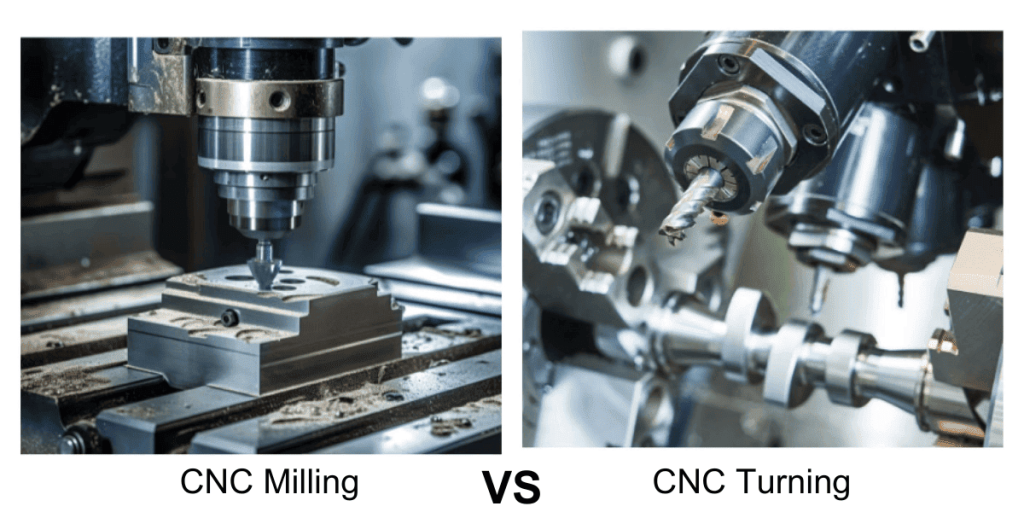
If you look at a car engine shaft and a smartphone housing, both rely on CNC machining but are made with very different methods. The shaft is typically produced through CNC turning, where the workpiece rotates to achieve perfect symmetry. The housing, on the other hand, is shaped through CNC milling, where a cutting tool carves out complex contours and cavities.
These two processes, milling and turning, form the foundation of precision manufacturing. While they share the same goal of shaping raw material into usable parts, the way they achieve it, their strengths, and their limitations are quite different. In this article, we'll explore what sets them apart, where each process excels, and how they often complement one another.
What is CNC Milling?
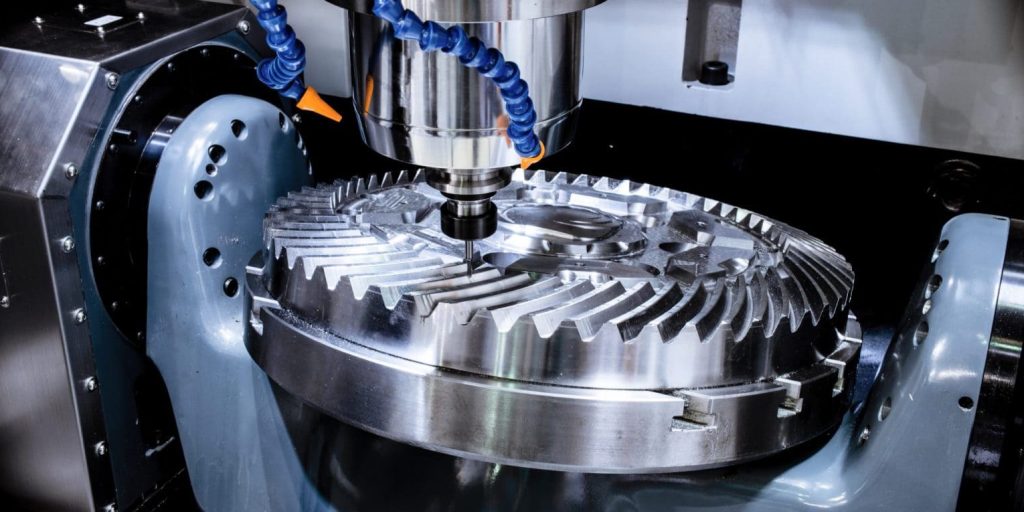
CNC milling is a subtractive manufacturing process that removes material from a solid block (called a workpiece) using a rotating cutting tool. Unlike turning, where the part itself rotates, milling keeps the workpiece fixed while the cutting tool spins and moves along multiple axes, commonly the linear X, Y, and Z directions.
These machines are classified by the number of axes they can control simultaneously:
- 3-axis milling: Operates along the basic X (left-right), Y (front-back), and Z (up-down) linear axes only.
- 4-axis milling: Adds a rotational axis (typically A-axis), allowing the workpiece or tool to rotate, which enables machining features on multiple sides without repositioning.
- 5-axis milling: Includes the three linear axes plus two rotational axes (often A and B or A and C), providing full simultaneous movement for accessing complex angles, undercuts, and contoured surfaces in a single setup.
This freedom of movement makes milling especially effective for creating parts with flat surfaces, slots, cavities, and intricate geometries. Because of its versatility, milling is ideal for producing prismatic parts and complex shapes. It is commonly used to manufacture molds, dies, housings, and enclosures where precise detailing is required. Multi-axis milling machines can even produce highly contoured surfaces and undercuts that are impossible to achieve with simpler machining methods.
What is CNC Turning?
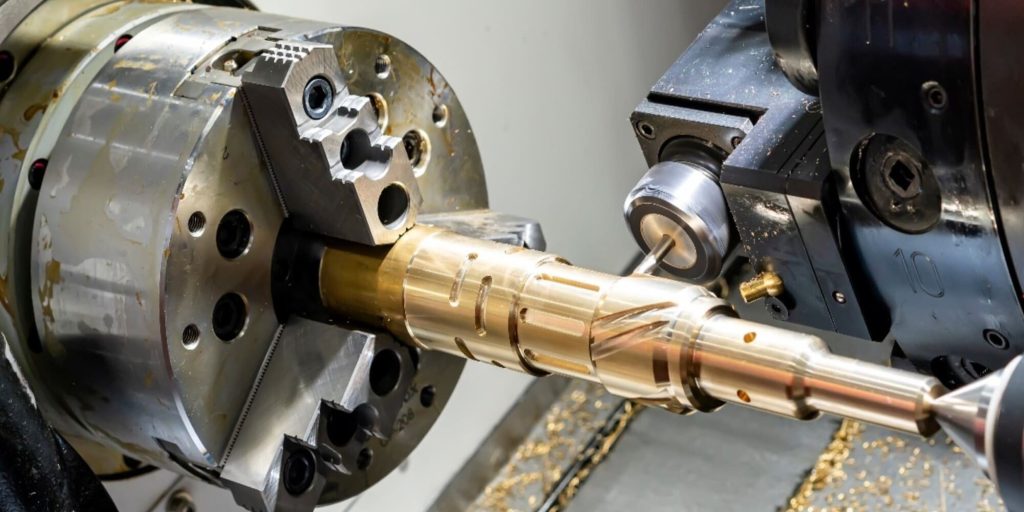
CNC turning is a subtractive manufacturing process where the workpiece itself rotates at high speed while a stationary cutting tool removes material. This takes place on a CNC lathe, which precisely shapes parts that are symmetrical around a central axis, often called rotationally symmetric or cylindrical components. The process excels at producing smooth surfaces, consistent diameters, and accurate round features.
Common operations performed on CNC turning machines include:
- Facing: Creating a flat, smooth end surface perpendicular to the axis by removing material from the face of the workpiece.
- Straight/External Turning: Reducing the outer diameter to achieve precise cylindrical shapes, the core of most turning work.
- Grooving/Parting: Cutting narrow channels (grooves) or fully separating (parting off) sections of the workpiece.
- Threading: Forming external or internal screw threads for bolts, nuts, or fittings.
- Boring: Enlarging or finishing internal holes to exact diameters and smooth finishes.
- Drilling: Creating centered holes along the axis using rotating tools (live tooling on advanced lathes).
- Knurling: Pressing a patterned texture (e.g., diamond or straight lines) onto the surface for improved grip, often on handles or knobs.
- Taper Turning: Producing conical shapes by angling the tool or workpiece path.
By programming precise tool paths, feed rates, and cutting angles, CNC turning can efficiently create complex contours, tapers, grooves, and threads on round parts. The result is a highly productive process that delivers excellent surface finish, tight tolerances, and repeatability, making it the preferred method for parts like shafts, pins, bushings, fittings, and threaded components in industries from automotive to medical.
Key Differences Between Milling and Turning
Although both milling and turning are CNC machining processes, they differ in how material is removed, the shapes they create, and how they are applied in manufacturing. Let's examine the differences in more detail.
Motion
The defining difference lies in the motion of the cutting process. In milling, the tool rotates at high speed and moves along multiple axes, while the workpiece stays fixed. This allows the tool to cut across different planes, creating flat surfaces and complex features. In turning, the situation is reversed; the workpiece rotates while a stationary tool trims material away, producing smooth, round shapes.
Part Geometry
CNC milling is well-suited for prismatic shapes, parts with flat faces, angles, pockets, and intricate contours. It excels when the design requires multiple surfaces or features that intersect at different angles. CNC turning, on the other hand, is the natural choice for cylindrical or conical components, where symmetry around a central axis is critical. A simple way to think about it:
- Housings, brackets, and molds are milled;
- Shafts, bushings, and rods are turned.
Machine Setup
Milling is performed on milling centers or machining centers, which use tool changers and multi-axis movement to handle different cutting operations in one setup. These machines can range from simple 3-axis mills to advanced 5-axis systems capable of sculpting complex surfaces.
Turning takes place on lathes, where the main spindle rotates the workpiece and the cutting tool advances in controlled paths. Modern manufacturing increasingly uses mill-turn (or multitasking) machines, which combine both milling and turning operations in a single setup, reducing the need to transfer parts between separate machines.
Production Efficiency
When it comes to efficiency, turning often has the edge for large batches of simple, round parts. A lathe can quickly remove material and produce consistent, repeatable results, making it ideal for high-volume production. Milling is more flexible but usually slower, especially when working on multiple surfaces or intricate geometries. This makes milling a better fit for prototyping, custom jobs, and complex designs where precision outweighs raw speed.
Material Removal Rate
Turning generally provides a higher material removal rate for cylindrical components because the cutting tool engages the entire surface evenly as the workpiece spins. It also produces excellent surface finishes with fewer tool passes.
Milling, by contrast, offers superior control over small details and complex shapes, especially in multi-axis setups where tools can reach undercuts or angled features. Both methods are capable of tight tolerances, but their efficiency and precision depend heavily on the geometry of the part.
Get an instant quote from Xmake by uploading your design file today, and enjoy fast, reliable delivery with our expert manufacturing services.
Start a QuoteMilling vs Turning Overview
| Feature | CNC Milling | CNC Turning |
| Motion | Tool rotates, workpiece fixed | Workpiece rotates, tool stationary |
| Best for Geometry | Prismatic, flat, or complex 3D shapes | Cylindrical, conical, and round shapes |
| Machine Type | Milling center (multi-axis) | Lathe |
| Efficiency | Flexible, good for complex or one-off parts | Faster for high-volume round parts |
| Material Removal | Moderate, with fine detail control | High for cylindrical parts |
| Typical Examples | Smartphone housing, molds, aerospace brackets | Shafts, bushings, threaded rods, fasteners |
How Milling and Turning Work Together?
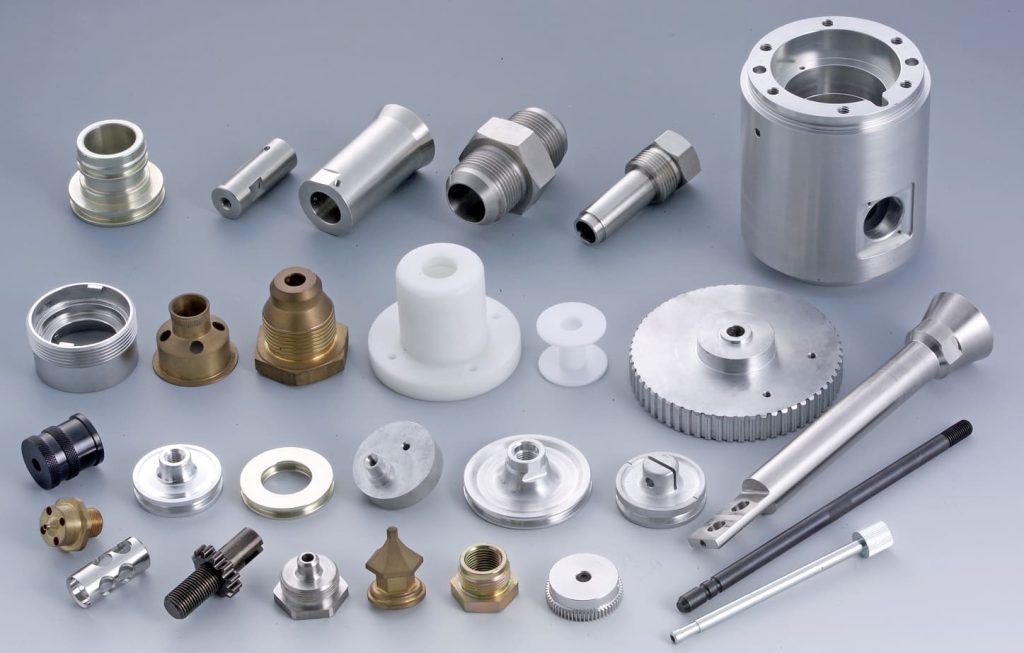
In many manufacturing projects, milling and turning are complementary processes rather than alternatives. A part may be turned first to create its basic cylindrical shape, then milled to add flat surfaces, slots, or intricate features.Â
Combining the two processes allows manufacturers to achieve both geometric precision and complex detailing, making it possible to produce parts that would be difficult or impossible with a single method. This synergy is especially common in industries like aerospace, automotive, and medical devices, where parts often require a mix of round and multi-surfaced features.
Choosing Between Milling and Turning
Selecting the right process depends on several key factors. Considering these can help ensure efficiency, accuracy, and cost-effectiveness:
- Geometry: If the part is primarily cylindrical or round, turning is usually the more efficient choice. For parts with flat surfaces, pockets, or complex 3D features, milling is generally preferred.
- Tolerance and Surface Finish: Both processes can achieve tight tolerances, but turning generally delivers superior surface finish and concentricity on round features with less effort. Milling excels at precise flatness, perpendicularity, and intricate multi-axis features.
- Production Volume: High-volume production of simple cylindrical parts favors turning due to its speed and repeatability. Milling is better for prototypes, custom parts, or low-volume runs where flexibility is important.
- Material Properties: Both processes handle a wide range of metals, plastics, and composites, but material machinability, hardness, and thermal behavior can tip the scales. Turning often excels with harder or brittle materials due to continuous cutting and better concentricity control. Milling provides more flexibility for heat-sensitive or complex-material parts, with better vibration management in intricate setups.
- Cost Considerations: Turning typically requires less setup and can reduce machining time for round parts, lowering costs in bulk production. Milling, though potentially more expensive per part, adds value through its ability to produce complex features in a single setup.
Conclusion
CNC milling and turning are both essential techniques in modern manufacturing, each with its own strengths and ideal applications. Milling shines in producing complex, multi-surfaced parts, while turning is highly efficient for cylindrical and symmetrical components.Â
In many cases, combining both methods allows for parts that meet precise specifications and intricate designs. For businesses looking to leverage expert machining capabilities, Xmake's CNC services offer reliable solutions for both milling and turning, ensuring high-quality results across a wide range of applications.
FAQs About Milling vs Turning
What are the disadvantages of CNC milling?
CNC milling can be slower and less efficient than turning for simple cylindrical parts. It often requires higher setup costs due to multi-axis machines and tooling, and tool wear can be significant when cutting hard materials or performing complex operations. Milling also demands more space and maintenance for advanced machining centers.
Can a CNC mill replace a lathe?
Lathes are specifically designed for spinning the workpiece, providing higher efficiency, better surface finish, and faster production for symmetric shapes. In many cases, the two processes complement each other rather than substituting entirely.
What is the hardest material to mill?
Materials with high hardness and toughness, such as tungsten carbide, hardened steels, and certain titanium alloys, are among the most difficult to mill. These materials require specialized cutting tools, lower feed rates, and careful cooling to prevent tool wear or damage, making machining more challenging and time-consuming.