
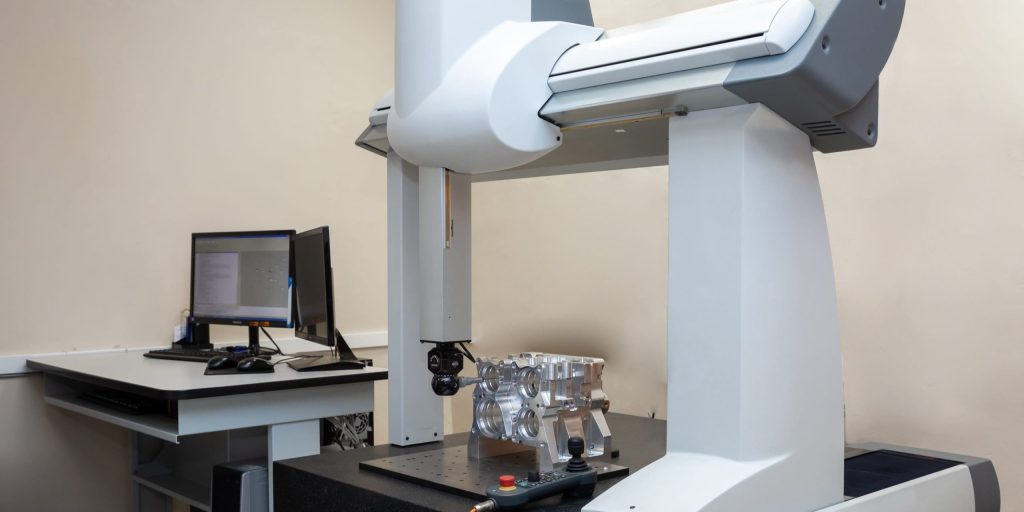
A Coordinate Measuring Machine (CMM) is a precision device used in manufacturing and quality control to measure the geometric characteristics of a physical object. It operates by using a sensitive probe to detect discrete points on an object's surface in three-dimensional space (x, y, z). The CMM then uses this data to verify that the manufactured part meets the exact specifications of its original digital design. This process is essential for ensuring part accuracy, functionality, and interchangeability in industries where precision is non-negotiable.
What is CMM Machine?
CMM stands for Coordinate Measuring Machine, which is a device that measures the physical geometric characteristics of an object. In simple terms, think of it as a highly sophisticated, super-precise robotic arm that “feels” an object to measure its exact dimensions. Much like a blind person uses their hands to understand an object’s shape and size, a CMM machine uses a sensitive probe to touch countless points on a part, creating a detailed 3D map. This map is then compared against the original digital design to verify that the part is manufactured correctly.
This process is critical for quality control, guaranteeing that parts fit together perfectly and function as intended. Without CMMs, mass production of complex components for industries like aerospace and medical devices would be virtually impossible.
Core Components of a CMM Machine
To understand how a CMM works, we need to break down its main components. Each part plays a vital role in ensuring the machine’s incredible accuracy.
Main Structure of Different Types of CMM Machines
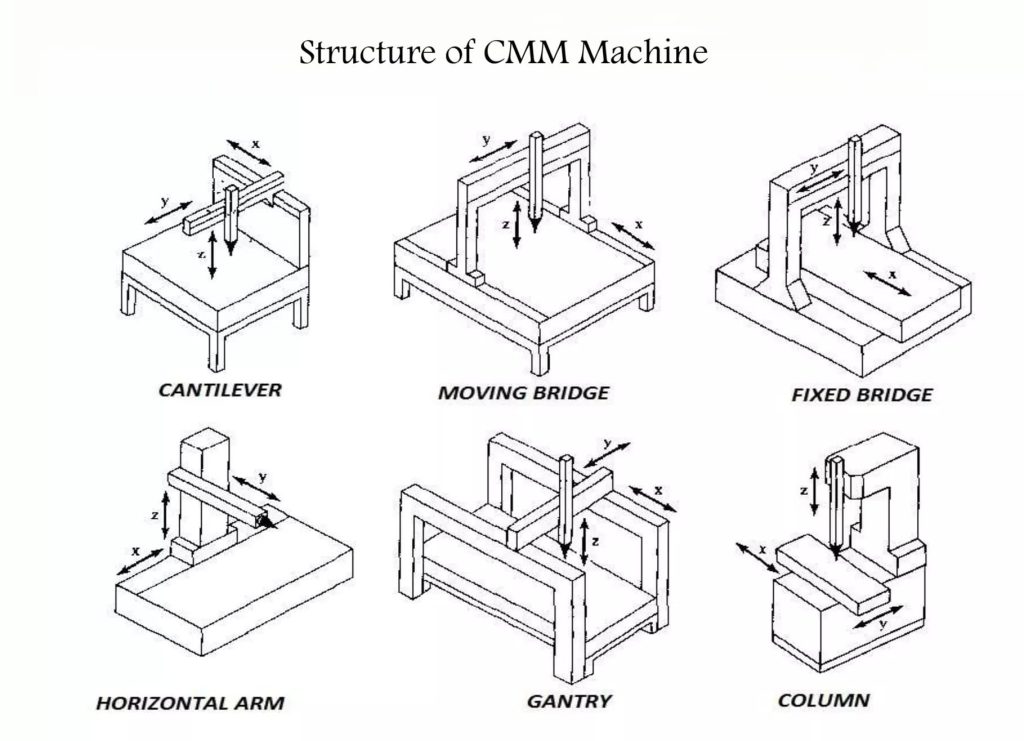
This is the physical body of the CMM. The four most common types of CMMs are categorized by their frame, each with a unique design for specific measurement needs.
- Bridge: The most common type, offering a great balance of accuracy and size. The probe moves along an overhead “bridge” supported by two legs, which gives it high rigidity and stability. This design is versatile and used for a wide variety of parts, from small electronic components to medium-sized automotive parts.
- Cantilever: Features a single, unsupported arm. This design is best for smaller, lighter parts and offers fast access to the measurement volume. Its open structure allows for quick loading and unloading of parts, making it a great choice for high-volume inspection on a production line.
- Gantry: This is essentially a larger version of the bridge type, designed to handle very large and heavy parts, such as car bodies, large castings, or aircraft frames. The Gantry CMM is typically mounted on a foundation, allowing it to move along a massive measuring area to inspect objects that wouldn’t fit on a standard CMM table.
- Horizontal Arm: This CMM is unique in that its measuring arm extends horizontally from a vertical column. It is specifically designed to measure large, flat, and thin parts, such as sheet metal, automotive body panels, or large castings. They are often used in pairs to inspect both sides of a part simultaneously.
| CMM Type | Best For | Pros | Cons |
| Bridge | General-purpose parts | + Excellent stability and high rigidity. + Versatile and adaptable for many applications. + Widespread use means easier access to training and support. |
- Can have a large footprint relative to its measuring volume. - Slower part loading and unloading compared to a cantilever. |
| Cantilever | Small, complex parts | + Provides excellent access to the measuring volume. + Faster loading/unloading for high-volume inspection. + A more compact design suitable for smaller workshops. |
- Lower structural rigidity can impact long-term accuracy. - Limited to a smaller measuring volume. |
| Gantry | Very large, heavy parts | + Capable of measuring massive objects that other CMMs cannot. + The highest load-bearing capacity. + Provides a wide, open work area. |
- Requires a very large footprint and a strong foundation. - Very high initial investment cost. |
| Horizontal Arm | Large, thin parts | + Ideal for measuring large and flat parts. + Excellent accessibility to the work area. + Can be used in pairs for fast, simultaneous measurement. |
- Lower accuracy compared to bridge or gantry types due to less rigidity. - Requires a large footprint to accommodate the arm's range. |
Probing System
This is the “finger” of the CMM. It’s the device that makes contact with the part to take measurements. Probes come in a variety of forms:
- Touch-Trigger Probes: The most traditional type. These probes register a coordinate (x,y,z) when a physical stylus touches the part’s surface. They are highly accurate but can be slower as they require discrete contact points.
- Laser Scanners: These are non-contact probes that use a laser beam to rapidly scan the surface of a part. They are ideal for complex geometries and capturing vast amounts of data quickly, creating what’s known as a “point cloud.”
Drive System
This is what moves the CMM’s arm along its axes. The system uses high-precision linear bearings and motors to ensure perfectly straight and consistent movement. Any deviation in this movement would lead to inaccurate measurements.
Controller and Software
This is the “brain” of the operation. The controller receives the data from the probe, and the software translates those thousands of coordinates into a detailed, easy-to-read report. Modern CMM software can directly import CAD (Computer-Aided Design) models, allowing for an immediate digital comparison between the part and its design.
Get an instant quote from Xmake by uploading your design file today, and enjoy fast, reliable delivery with our expert manufacturing services.
Start a QuoteHow a CMM Machine Works?
The process of measuring a part with a CMM is a precise, multi-step operation.
- Planning and Fixturing: Before any measurement begins, the part is securely placed on the CMM’s measuring table. Proper fixturing is critical to ensure the part doesn’t move during the process, as even the slightest shift can ruin the measurement.
- Probing: The probe is guided over the surface of the part, either manually by an operator or, more commonly, by an automated program. For a touch-trigger probe, it makes contact at thousands of specific points. For a laser scanner, it sweeps across the surface, collecting a continuous stream of data.
- Data Acquisition: As the probe moves, the CMM’s sensors record the precise coordinates (x,y,z) of each point. This raw data forms a highly detailed digital representation of the part’s surface.
- Data Analysis: The CMM software takes the collected data and compares it to the part’s original CAD model. It instantly identifies any deviations, no matter how small, and generates a detailed report showing whether the part is within its specified tolerances.
What many people don’t realize is that a CMM’s accuracy can be affected by its environment. Even a temperature change of just 1°C or a small vibration from an adjacent machine can cause a part to expand or contract, leading to an inaccurate measurement. For this reason, CMMs are often housed in dedicated, climate-controlled labs to ensure the most reliable results.
The Importance of Precision in CMM Machine
Beyond just knowing what a CMM does, it’s crucial to understand why its accuracy is so important. A lack of precision can have devastating consequences, both financially and in terms of safety. In manufacturing, a single faulty part can lead to expensive scrapping, costly product recalls, and significant legal liabilities. The stakes are even higher in critical industries like aerospace and medical devices, where a lack of precision can risk human lives.
The benefits of prioritizing precision in manufacturing are numerous:
- Financial Safeguard: CMMs prevent expensive errors by catching defects early, avoiding costly scrapping of materials and labor, and saving companies from potentially ruinous product recalls.
- Enhanced Reputation: Consistently producing high-quality, precise parts builds a reputation for reliability and excellence, leading to increased customer trust and repeat business.
- Guaranteed Safety: In critical applications, such as medical implants or aerospace components, precision is a matter of life and death. The use of a CMM provides the ultimate assurance that a part will perform safely and reliably.
Ultimately, the investment in a CMM machine is not just a cost; it's a safeguard that prevents these much larger problems and ensures every part is exactly as it was designed.
Uses of CMM Machines
CMM machines are indispensable across numerous industries, where precision is a matter of safety and quality.
Aerospace
In the aerospace industry, where a single faulty component can have devastating consequences, CMMs are the primary tool for quality assurance. They are used to inspect everything from engine components like turbine blades and fuel nozzles to structural airframe parts. The high level of precision CMMs provide is essential to ensure flight safety and the reliable operation of aircraft.
Automotive
CMMs are fundamental to the automotive industry, from prototyping to mass production. For example, they are used to inspect engine blocks, crankshafts, and transmission components. Gantry CMMs are often used to check the full body-in-white (the welded, unpainted vehicle body) to ensure all mounting points and features are in the correct position before the final assembly. This ensures all parts fit together perfectly on the assembly line.
Rapid Prototyping
In the world of rapid prototyping, where speed is critical, CMMs provide the final and most important check. When a part is 3D printed or quickly machined, a CMM is used to verify that the final product matches the digital design, guaranteeing that prototypes are not just fast, but also accurate. This allows designers and engineers to quickly iterate and test new ideas with full confidence in the part’s dimensions.
CNC Machining
After a part has been created through CNC machining, a CMM is the gold standard for final inspection. For a company like Xmake, this is a critical step in the quality control process. For example, a custom-machined aluminum bracket for a company in Chicago needs to fit perfectly into a larger assembly. By using a CMM, we can verify every dimension is within a micron of the CAD model, guaranteeing the part will work the first time. This level of quality assurance is what separates a good supplier from a great one.
CMM vs. Other Measurement Tools
How does a CMM fit into the world of metrology? Here's how it compares to some other common tools.
| Tool | Caliper | Micrometer | Optical Scanner | CMM |
| Accuracy | Low | Medium | High | Very High |
| Speed | Fast | Slow | Very Fast | Medium |
| Part Complexity | Simple features | Single features | High | High |
| Cost | Very Low | Low | High | Very High |
| Pros |
+ Extremely portable and simple to use. + Best for quick checks on a shop floor. |
+ More accurate than a caliper. + Good for verifying specific dimensions like thickness or diameter. |
+ Captures vast amounts of data very quickly. + Non-contact, ideal for delicate or soft parts. + Generates a full 3D point cloud of the object. |
+ The gold standard for precision. + Can measure complex geometries and internal features with high accuracy. + Provides detailed reports and analysis against CAD models. |
| Cons |
- Low accuracy. - Not suitable for complex features or internal geometries. - Prone to operator error. |
- Very slow for multiple measurements. - Only measures one dimension at a time. |
- Can struggle with reflective or transparent surfaces. - Often less accurate than a CMM for critical GD&T features. |
- High initial cost and requires a specialized, climate-controlled environment. - Slower for simple measurements than other tools. |
While calipers and micrometers are great for quick checks of simple dimensions, they are not suitable for measuring complex geometries or ensuring overall part integrity. Optical scanners are fast and capture vast amounts of data, but they can struggle with reflective surfaces and are often less accurate than a CMM for critical dimensions. The CMM remains the gold standard for verifying the most complex and precise parts.
Conclusion
The CMM machine has evolved from a manual, operator-driven tool into a highly automated, indispensable component of modern manufacturing. As technology continues to advance, we will see CMMs become even more integrated with robotics and artificial intelligence for fully automated quality control systems.
For companies that rely on precision manufacturing, understanding the role of a CMM is key. It is the final check, the ultimate assurance that your part is exactly as it was designed.
Frequently Asked Questions
Is a CMM a CNC machine?
A CMM (Coordinate Measuring Machine) is an inspection device for measuring part dimensions and geometry. A CNC machine is for manufacturing (cutting, shaping parts).
They differ in purpose: CMM verifies; CNC produces. Modern CMMs may use CNC-like controls, but they are not the same.
Which software is used for CMM?
Common CMM software includes:
- PC-DMIS (Hexagon) – most widely used, very versatile
- CALYPSO (Zeiss) – intuitive, strong on Zeiss machines
- MCOSMOS (Mitutoyo) – for Mitutoyo systems
- CMM-Manager (QxSoft) – good for retrofits
- PolyWorks (InnovMetric) – universal, popular for complex inspection
PC-DMIS is the industry standard for broad compatibility. These are now much shorter while still clear and accurate.