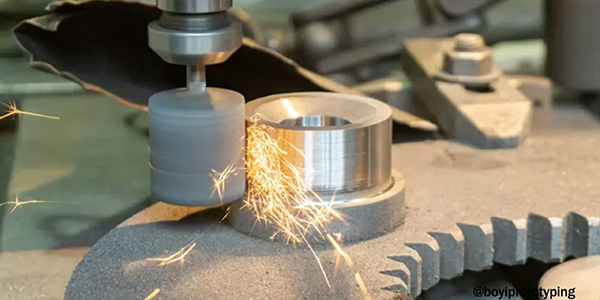
Grinding is a finishing process that involves removing minute amounts of material from a workpiece’s surface using a high-speed rotating grinding wheel. The principle behind this process relies on the minute abrasive grains on the surface of the grinding wheel, which perform micro-cutting and abrasive action on the workpiece at high speeds to achieve higher dimensional accuracy and surface finish.
Compared to conventional CNC turning or milling (±0.001“ to ±0.005”), grinding typically enables tighter tolerance control, with accuracy reaching ±0.0001 inches. Therefore, grinding is typically integrated into the final stage of production to improve dimensional accuracy and surface finish, especially for industries with strict precision requirements such as aerospace, automotive, and precision machinery manufacturing. In this article,we will introduce the characteristics of grinding, its common types, application scenarios, and how it differs from other machining processes.
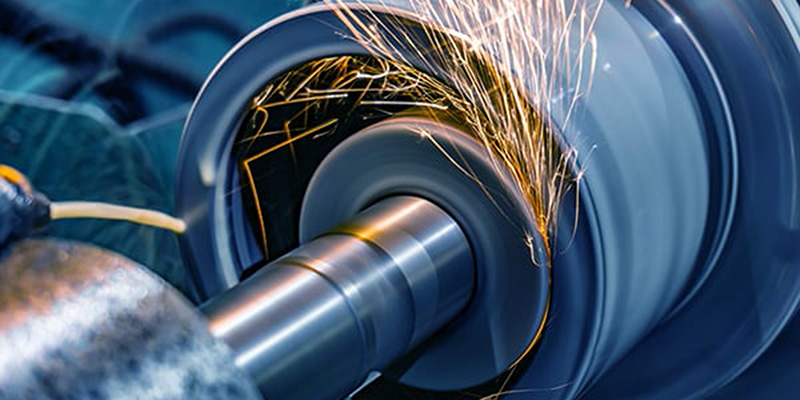
Key Characteristics of Grind Machining
The main characteristics of the grinding process include the following:
- High machining accuracy:Grinding is a type of finishing process that can achieve high dimensional accuracy, with precision as high as ±0001 inches (IT5 grade), making it suitable for machining high-precision parts.
- Superior surface quality: Grinding can achieve low surface roughness, with Ra values typically ranging from 0.8 to 0.2 μ Some high-precision grinding processes can even achieve superfinishing results, making it particularly suitable for parts with stringent surface quality requirements.
- Minimal machining allowance: Rough grinding has a material removal rate of approximately 10–100 mm³/s. Because the amount of material removed per pass is small, it is easier to control dimensional accuracy and surface stability, making it suitable as a final finishing process for parts. For rough machining scenarios requiring rapid removal of large amounts of material, turning or milling is generally recommended as the preferred method.
- Machining of high-hardness materials: In addition to conventional materials, grinding can process high-hardness materials such as hardened steel and cemented carbide, as well as heat-treated parts and brittle materials like ceramics and glass. Anything that cannot be machined with conventional cutting tools can be ground.
Types of Grinding Machining
Grinding processes can be classified into several types based on the machining method, workpiece geometry, and application scenario. Different grinding methods are designed for different precision requirements, surface conditions, and part structures. The following are some of the most commonly used grinding machining types in industrial manufacturing.
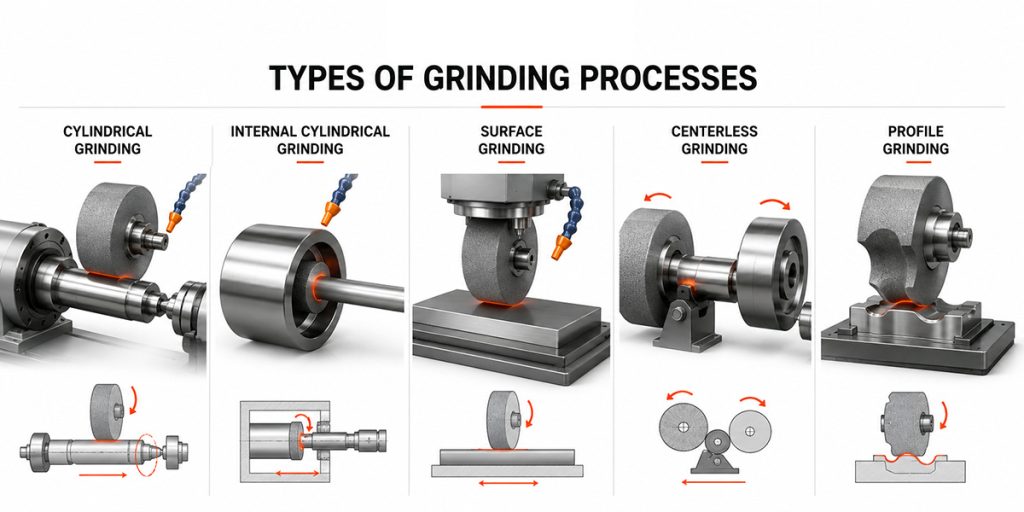
| Grinding Type | Definition | Best for | Typical Applications |
|---|---|---|---|
|
Cylindrical Grinding |
Used to machine the outer cylindrical or conical surfaces of workpieces to improve dimensional accuracy, roundness, and surface roughness. |
High-precision external cylindrical, cylindrical, and conical surface finishing |
Drive shafts, spindles, pins |
|
Internal Cylindrical Grinding |
Used to machine the interior of workpiece bores to improve bore dimensional accuracy, roundness, and internal surface roughness |
High-precision internal bore and mating bore machining |
Sleeves, gear bores, bearing sleeves |
|
Surface Grinding |
Machining workpiece flat surfaces using the circumference or end face of a grinding wheel to ensure flatness, parallelism, and surface roughness. |
Finishing of horizontal, vertical, inclined, and reference planes |
Mold plates, guideways, sliders |
|
Centerless grinding |
Workpieces do not require centering with centers or chucks; positioning relies on a support tool and guide wheel to achieve continuous external cylindrical grinding. |
Workpieces are not centered; high-efficiency batch processing by grinding between the grinding wheel and the guide wheel |
Cylindrical pins, needle rollers, small shaft standard parts |
|
Profile grinding |
The grinding wheel is dressed to a specific profile to machine complex surfaces that match the grinding wheel’s contour in a single pas |
Machining of complex profiled surfaces, contours, and irregular cross-sections |
Gears, threads, and form tools |
Benefits of Grind Machining
The main advantages of grinding:
1.High machining accuracy and excellent surface quality, capable of meeting the machining standards of industries with stringent requirements.
2.Grinding can process materials such as cemented carbide, ceramics, and glass that are difficult to machine consistently using other processes.
3.Compared to turning or milling, grinding can be used for the final finishing stage of parts, improving surface quality and fit accuracy.
4.Wide range of applications: It can grind external cylindrical surfaces, internal bores, flat surfaces, threads, gears, and more.
Grinding vs milling vs Turning
Grinding, milling, and turning are three common metal-cutting processes. They differ significantly in terms of their operating principles, key characteristics, and applications, as detailed in the table below:
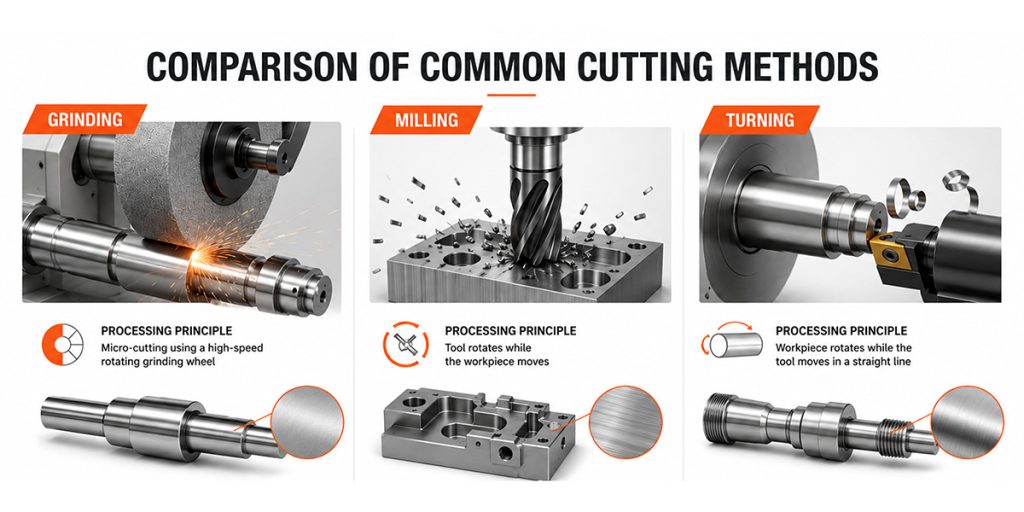
| Cutting Method | Grinding | Milling | Turning |
|---|---|---|---|
|
Processing Principle |
Micro-cutting using a high-speed rotating grinding wheel |
Tool rotates while the workpiece moves |
Workpiece rotates while the tool moves in a straight line |
|
Machining Accuracy |
IT5–IT6 |
IT7–IT9 |
IT6–IT8 |
|
Surface roughness Ra |
0.1–0.8 μm |
1.6–6.3μm |
0.8–3.2 μm |
|
Single-pass cutting depth |
0.01–0.05 mm (finish grinding) |
2–6 mm (rough milling) |
2–8 mm (rough turning) |
|
Material Hardness |
Up to HRC 60 or higher (including hardened steel and ceramics) |
Generally ≤ HRC 50 |
Generally ≤ HRC 45 |
|
Key Applications |
Finishing |
Heavy material removal (rough machining) |
Machining of rotary parts |
Applications of Grind Machining
As a critical process in precision manufacturing, grinding is prevalent across nearly all high-end manufacturing sectors, playing an irreplaceable role particularly in industries with stringent requirements for precision, hardness, and surface quality.
1. Automotive Manufacturing: Grinding is the core process for the finishing of precision automotive components. It is widely used in the machining of critical parts such as crankshafts, gears, and camshafts. Grinding improves the dimensional accuracy, roundness, and surface wear resistance of parts to meet the assembly precision and service life requirements of engines and transmission systems.
2. Aerospace: In the aerospace sector, grinding is commonly used for the finishing of difficult-to-machine materials such as high-temperature alloys and titanium alloys. It effectively controls dimensional stability and surface quality, and is widely applied in the manufacture of critical components such as turbine blades, engine discs, and landing gear.
3. Mechanical Manufacturing: Grinding is a core machining process in mechanical manufacturing for achieving high precision and hardness. It is widely used in the fields of transmission systems, molds, and machine tool base components to achieve extremely high flatness and wear resistance. In particular, hardened steel and difficult-to-machine materials almost entirely rely on grinding.
4.Medical Devices: Many components in medical devices are made of hard materials with high precision requirements and demand smooth surfaces; therefore, grinding is essential for finishing these parts, such as common artificial joints, bone screws, and surgical instruments.
5.Precision Instruments: The precision instrument industry imposes stringent requirements on dimensional accuracy and surface finish. Grinding is commonly used to process parts such as precision gauge blocks, instrument spindles, and precision guideways, ensuring accurate measurements and a long service life for the instruments.
Grinding Machining Case Studies
XMAKE has handled a wide range of high-precision grinding applications involving hardened steel, hydraulic components, and wear-resistant parts. The following is a representative grinding case for a precision hydraulic piston rod used in hydraulic systems.
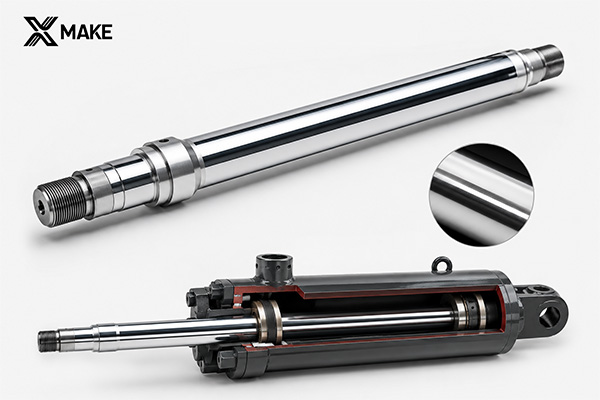
I. Basic Part Information
This project involved a precision hydraulic piston rod used inside hydraulic cylinders for construction machinery.
The part operates under continuous reciprocating motion and requires high sealing reliability to prevent oil leakage under pressure.
Material: Quenched 40Cr steel (HRC 52–55)
II. Machining Challenges
The customer required:
Outer diameter tolerance: ±0.005 mm
Cylindricity: ≤0.003 mm
Surface roughness: Ra ≤ 0.2 μm
Because the workpiece was already hardened, conventional turning tools wore quickly and could not maintain stable micron-level tolerances.
In addition, turning marks on the surface were too rough for hydraulic sealing applications and could increase the risk of oil leakage and seal wear.
III. Why Grinding Was Required
Cylindrical grinding was selected as the final finishing process to achieve:
Stable micron-level dimensional accuracy
Better cylindricity control
Mirror-level surface finish for sealing performance
Compared with turning and milling, grinding provided significantly better precision and surface consistency for hardened steel components.
IV. Final Results
After grinding optimization, the final part achieved:
Tolerance within ±0.004 mm
Cylindricity of 0.0025 mm
Surface roughness of Ra 0.16 μm
The component successfully passed customer validation and entered mass production.
Beyond hydraulic piston rods, XMAKE has extensive grinding machining experience across shafts, molds, hydraulic parts, and other high-precision components. We provide suitable grinding solutions based on different materials, hardness levels, and precision requirements. Contact the XMAKE engineering team for technical support and quotations.
When to Choose Grinding?
Grinding is a finishing process. It should be the preferred choice when the following conditions are met:
- Extremely high requirements for dimensional and geometric accuracy: When dimensional tolerances must be at IT6 or below, or when geometric tolerances such as flatness and parallelism require strict control, grinding is essential to ensure precision.
- Strict surface roughness requirements: When surface roughness must reach Ra 0.8 or lower, grinding achieves low friction and high wear resistance, making it the optimal process choice.
- Machining high-hardness materials: For difficult-to-machine materials such as heat-treated hardened steel, cemented carbide, and titanium alloys—which cannot be effectively machined with conventional cutting tools—grinding is the key method for shaping and finishing.
Summary
Grinding uses a grinding wheel as the cutting tool to remove minute amounts of material while rotating at high speeds. Thanks to this unique machining method, it achieves extremely high precision and excellent surface quality. By efficiently machining hard materials such as hardened steel, ceramics, and cemented carbide, grinding overcomes the limitations of turning and milling, and is widely used in fields such as automotive manufacturing, aerospace, and medical devices. In applications where high precision, hardness, and surface quality are required, grinding is an irreplaceable core process and serves as the technological foundation for high-end manufacturing.
XMAKE provides precision grinding services for hardened steel, stainless steel, titanium alloys, carbide, and other difficult-to-machine materials. Supported by strict process control and advanced inspection methods, we can achieve tolerances up to ±0.005 mm and surface finishes as fine as Ra 0.1 μm for demanding precision applications.
Upload your STEP files to receive instant quotes and automated DFM analysis within seconds, helping identify potential manufacturability and tolerance risks before production begins.
FAQ
1. Why is grinding the preferred method for high-hardness precision parts?
Because turning and milling cannot effectively machine high-hardness workpieces—which are prone to tool chipping—while grinding can process high-hardness materials such as hardened steel. Additionally, grinding achieves micron-level precision and a mirror-like finish with low surface roughness, meeting the requirements for precision assembly.
2. What materials can be processed using grinding?
Precision grinding can process the vast majority of industrial metals and non-metallic materials, including hardened steel, stainless steel, titanium alloys, aluminum alloys, cemented carbides, and ceramics, and is suitable for both hard and soft materials.
3. What surface roughness can be achieved?
Surface roughness can be as low as Ra 0.1 μm. This mirror-like finish is ideal for components requiring low friction and high durability, such as seals and precision bearings.
4. Will parts rust or develop surface defects after grinding?
Grinding does not alter the material composition but effectively removes scale and machining defects, providing a uniform, dense surface. If rust and corrosion protection are required, further cleaning, passivation, or coating treatments are necessary to further enhance the part’s durability.