Aluminum alloy parts left sitting for a few months develop a white powdery substance on their surfaces; aluminum structures near the coast show fine pitting after six months of use—this isn’t rust, but it’s not normal either. In fact, while aluminum doesn’t rust, that doesn’t mean it doesn’t corrode.
Many engineers and procurement professionals know that “aluminum is corrosion-resistant,” but they can’t clearly explain under what conditions those white spots and pitting on the surface go from being cosmetic issues to structural hazards. This article covers everything from corrosion types and triggers to protective solutions, helping you make informed decisions during material selection, design, and maintenance.
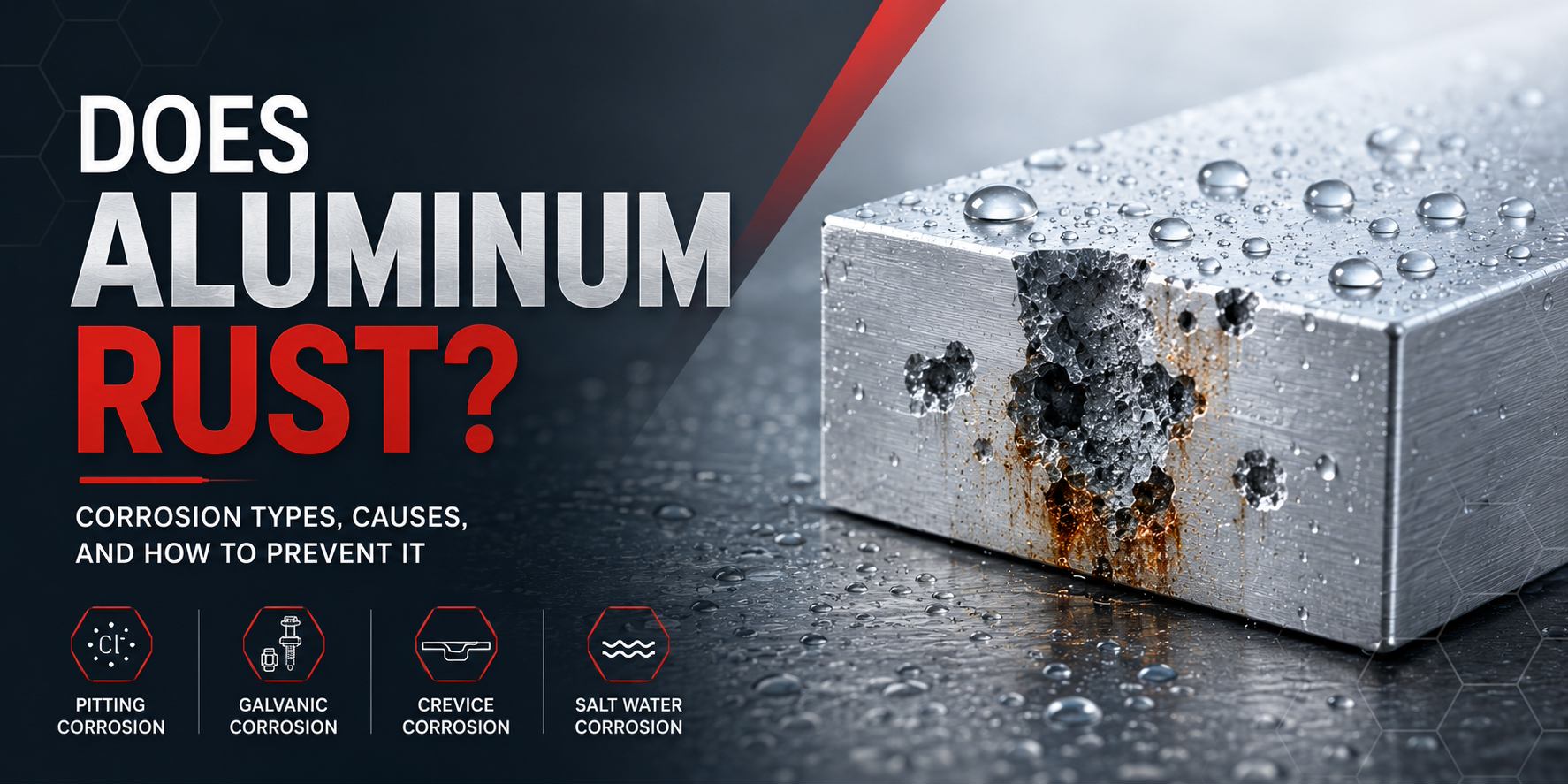
Does Aluminum Rust?
No, but it will corrode— and the answer is the same whether you call it aluminum or aluminium.
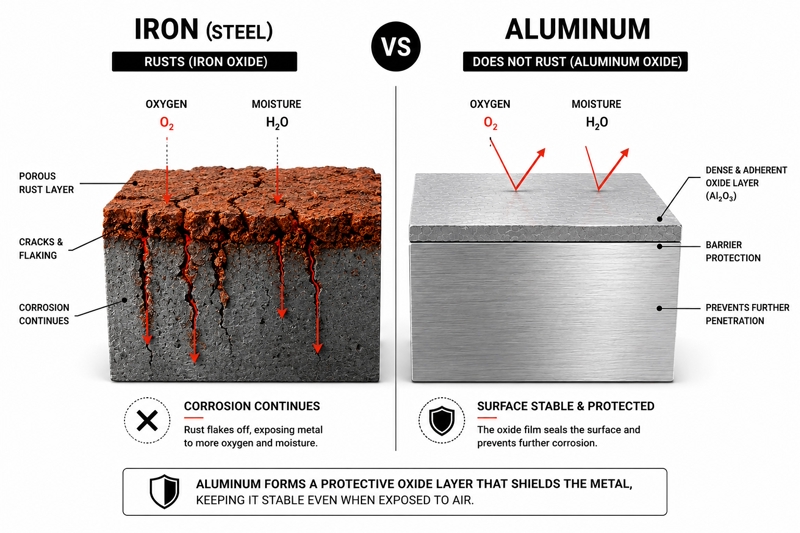
The fundamental difference between aluminum and iron lies in their oxidation behavior. Iron rusts (forming iron oxide), which has a porous structure that continues to flake off, exposing the underlying metal; in contrast, the aluminum oxide film formed on aluminum is dense and strongly adherent, automatically sealing the surface and preventing further penetration by oxygen and moisture. This is why aluminum parts remain stable for long periods when exposed to air.
However, this oxide film is not invulnerable. Chloride ions (found in seawater and de-icing salts), strong acids, strong alkalis, and direct contact with metals of higher potential can all cause localized damage to the oxide film, leading to various types of corrosion.Aluminum alloys containing copper or iron are more susceptible, which is why surface treatments are often specified for alloy components in demanding environments.
Therefore, the accurate statement is: aluminum is corrosion-resistant, but it is not rust-proof in all environments.
What Does Aluminum Corrosion Look Like?
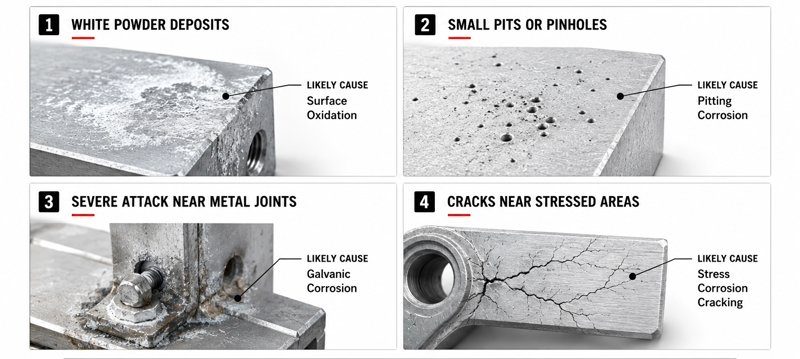
Aluminum corrosion does not always look the same. Different corrosion mechanisms produce different visual signs, and recognizing these symptoms is often the fastest way to identify the root cause.
| Symptom | Likely Cause |
|---|---|
|
White powder deposits |
Surface oxidation |
|
Small pits or pinholes |
Pitting corrosion |
|
Severe attack near metal joints |
Galvanic corrosion |
|
Cracks near stressed areas |
Stress corrosion cracking |
Once you recognize the symptom, the next step is understanding the corrosion mechanism behind it.
Types of Aluminum Corrosion
As mentioned earlier, not all forms of aluminum corrosion manifest in the same way. The white powder, pitting, and localized erosion commonly observed on aluminum metal surfaces are often caused by different corrosion mechanisms. Depending on the environment and exposure conditions, aluminum corrosion can generally be classified into the following categories.
Pitting Corrosion
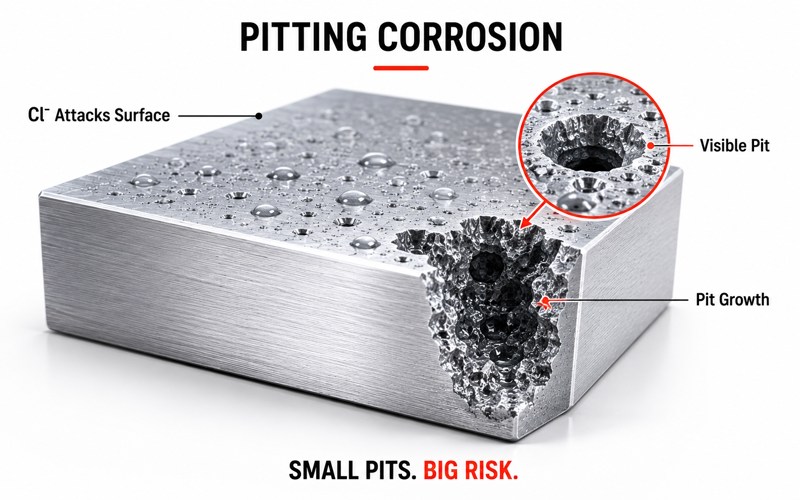
The most common form of corrosion, where corrosive ions such as chloride ions break down the oxide film on the aluminum surface, forming small holes that expand inward. Visually, this may appear as only fine pitting, but the pits continue to deepen, and prolonged exposure can compromise structural strength. It frequently occurs in humid, salt-laden environments.
Galvanic Corrosion
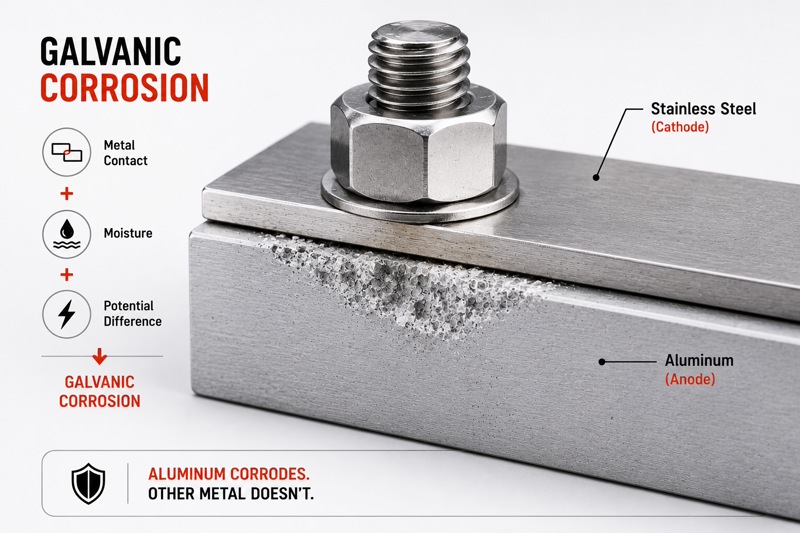
When aluminum comes into direct contact with metals of higher potential (such as copper or stainless steel) in a humid environment, the aluminum acts as the anode and undergoes accelerated corrosion. This is commonly found at the joints of dissimilar metal components. Damage is often concentrated near the contact surfaces; while not visually obvious, it progresses rapidly.
Crevice Corrosion
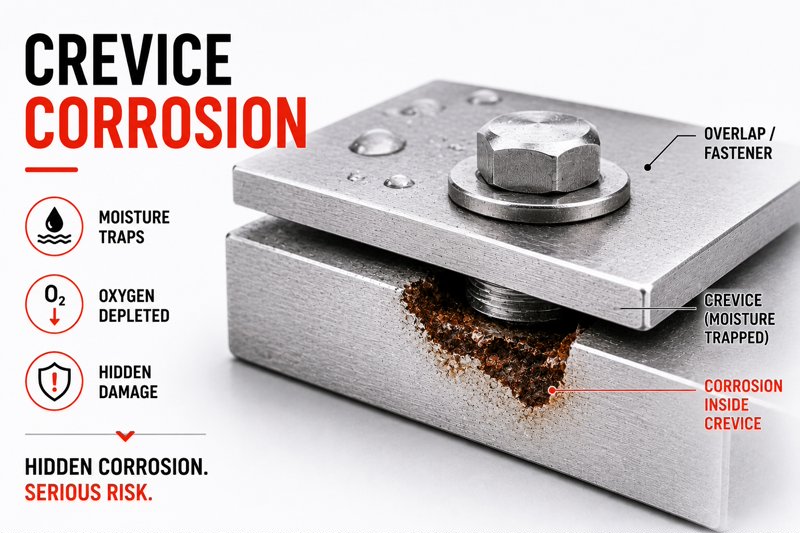
Crevice corrosion typically occurs within narrow crevices where moisture tends to accumulate and oxygen is easily depleted. Because this type of corrosion is often hidden beneath overlapping surfaces, gaskets, or fasteners, the material may have already suffered significant loss before any visible external damage appears.
Other Types
Other common types of corrosion include intergranular corrosion (which propagates along grain boundaries and is prevalent in high-strength alloys subjected to improper heat treatment), stress corrosion cracking (caused by the combined action of tensile stress and corrosive media), and filiform corrosion (fine filamentous propagation beneath paint films). While these types pose significant risks under specific operating conditions, they occur less frequently than the first three types.
Galvanic Corrosion: Aluminum with Other Metals
When aluminum comes into direct contact with a metal of higher potential in a humid environment, the aluminum acts as the anode and corrodes at an accelerated rate, while the other metal remains virtually unaffected—this is known as galvanic corrosion, and it is one of the most easily overlooked corrosion risks in engineering fasteners.
Whether it’s aluminum or aluminium, three conditions must be met simultaneously for galvanic corrosion to occur: direct electrical contact between the two metals, the presence of a continuous electrolyte (water, moisture, or saltwater), and a sufficiently large potential difference between the two metals. If any one of these conditions is absent, galvanic corrosion cannot occur.
Which Metal Combinations Are Risky?
When aluminum comes into contact with other metals in the presence of an electrolyte, galvanic corrosion may occur. The following table shows the compatibility of aluminum with common metals:
| Category | Compatible Metals | Safety Status | Notes |
|---|---|---|---|
|
Safe Combination (Similar potential, mild corrosion) |
Zinc, cadmium, galvanized steel |
Safe |
Potential is similar to aluminum; galvanic corrosion is virtually nonexistent |
|
Caution Required (Moderate potential, prone to corrosion in humid environments) |
Low-carbon steel, ordinary carbon steel |
Safe in dry conditions, hazardous in humid conditions |
In rain or water immersion, aluminum corrodes first; use insulating washers to isolate |
|
Dangerous Combinations (Large potential difference; strictly prohibited) |
Copper, brass, bronze, stainless steel, silver, nickel |
Direct contact strictly prohibited in humid environments |
The potential of copper/stainless steel is much higher than that of aluminum; in the presence of water, rapid corrosion and perforation will occur; rubber or plastic insulating washers must be used to separate them |
How to Prevent Galvanic Corrosion
1.Electrical isolation
When assembling in damp outdoor environments or making flange connections, use insulating washers, sleeves, or coatings between aluminum and dissimilar metals to break the electrical path and prevent the formation of galvanic cells.
2.Zinc-chromium coating
When mass-producing assemblies that pair aluminum components with carbon steel screws, apply a zinc-chromium surface coating to the steel fasteners. This coating has a potential close to that of aluminum, which isolates moisture and relies on the sacrificial zinc layer for corrosion protection, thereby reducing the potential difference between the metals.
3.Apply anti-seizing compound
When connecting aluminum and stainless steel threads in high-temperature environments or outdoor conditions, apply anti-seizing grease to the threads or mating surfaces. This fills gaps to prevent rainwater ingress and isolates conductive media.
Common Causes of Aluminum Corrosion
In normal conditions, the oxide film provides good protection for aluminum; however, under certain conditions, corrosion can cause damage. The following is a summary of the corrosion risks, causes, consequences, and corresponding measures for aluminum in various scenarios:
| Problem Scenario | Cause | Typical Consequences | Solution |
|---|---|---|---|
|
Saltwater/Coastal Environments |
Chloride ions damage the oxide film, causing pitting corrosion |
Small holes appear on the surface, damaging appearance and affecting strength |
Select 5xxx (magnesium) or 6xxx (magnesium-silicon) series alloys; anodize or recoat; regularly clean off salt deposits |
|
Contact with Dissimilar Metals |
Aluminum forms galvanic couples with copper and stainless steel in humid environments |
Accelerated corrosion near contact surfaces, resulting in white powder or deep pits |
Use insulating gaskets/coatings; select compatible aluminum alloys or coatings |
|
Strong acids/strong alkalis |
Cleaning agents and acidic industrial gases dissolve the oxide film |
Rapid dissolution of the oxide film, resulting in overall metal thinning |
Apply coatings, anodize + seal; switch to more corrosion-resistant alloys (e.g., aluminum-magnesium-silicon alloys); modify processes to avoid extreme pH levels |
|
High temperature/humidity combined with contaminants |
Acidic moisture accumulates in crevices or on surfaces |
Accumulation of corrosion products leads to swelling and cracking |
Design to prevent water/dust accumulation in crevices; use sealants or lubricating coatings; perform regular maintenance and cleaning |
Aluminum Corrosion in Salt Water
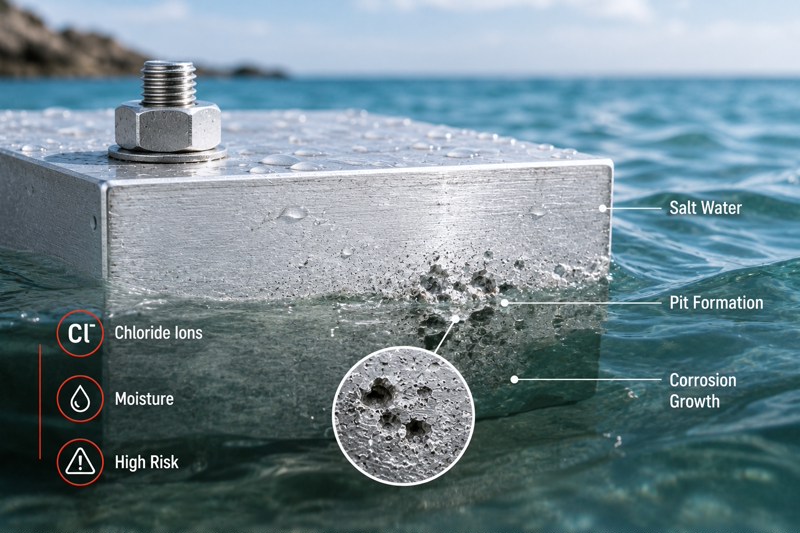
Salt water and aluminium are a well-known problematic combination — saltwater environments are the most common high-risk scenarios for aluminum corrosion, and they are also where many engineers encounter the most pitfalls when selecting materials and implementing protective measures.
Corrosion Mechanism
Chloride ions in seawater penetrate or locally break through the oxide film on the aluminum surface, exposing the metal substrate. The substrate forms microcells with the residual oxide film and impurities in the alloy, accelerating localized dissolution, which ultimately manifests as pitting corrosion or overall thinning.
Factors Affecting the Rate of Corrosion
- Salinity: The higher the salt concentration, the greater the number of chloride ions, and the faster the corrosion.
- Water Temperature: Higher water temperatures accelerate ion movement, leading to faster corrosion.
- Oxygen Content: The more oxygen present in seawater, the faster the corrosion.
- Alloy Grade: The 5xxx series (e.g., 5052, 5083) typically offers the best resistance to seawater corrosion, while copper-containing alloys like 2024 are significantly more susceptible to corrosion.
Common Protective Measures
- Anodizing: Thickening the aluminum oxide protective layer
- Applying organic coatings or anti-corrosion paint
- Sacrificial anodes (zinc blocks): Commonly used for marine aluminum components, allowing zinc to corrode first to protect the aluminum
- Selecting the right alloy: 5052 and 5083 are the preferred choices for coastal and seawater immersion environments
Corrosion Resistance of Common Aluminum Alloys
Due to differences in alloying elements, aluminum alloys from different series exhibit significant variations in corrosion resistance across various corrosive environments. The following sections provide a detailed explanation for each alloy series, accompanied by a summary comparison table.
Detailed Analysis of Corrosion Resistance for Common Aluminum Alloy Grades
1050 / 1060 (Series 1, Pure Aluminum): Excellent corrosion resistance; the oxide film is continuous and dense, with virtually no galvanic corrosion. However, it may be subject to minor electrolytic corrosion. Used for water purification containers and indoor corrosion-resistant components.
2024, 7075 (Series 2, Series 7 High-Strength Aluminum): Poor corrosion resistance; copper elements disrupt the continuity of the oxide film, making it prone to corrosion and pitting. Primarily used for high-strength structural components in aviation within dry environments.
3003/3004 (Series 3 Aluminum-Manganese Alloys): Good corrosion resistance, superior to Series 6 aluminum. Commonly used for outdoor sheet metal, heat exchanger housings, and tanks.
5052/5083 (Series 5 aluminum-magnesium alloys): Offer the best corrosion resistance, with excellent resistance to seawater and coastal salt fog; the top choice for marine components and coastal equipment.
6061/6063 (Series 6 aluminum-magnesium-silicon alloys): Exhibit good resistance to atmospheric corrosion after anodizing but are prone to corrosion in high-salt environments; the primary aluminum alloys for general machining applications.
| Alloy Grade | Corrosion Resistance Rating | Typical Operating Environments |
|---|---|---|
|
1050/1060 |
★★★★★ |
Indoor environments, fresh water, mildly corrosive media |
|
2024/7075 |
★★☆☆☆ |
Indoor dry environments for high-strength structural components; surface coating required for outdoor use |
|
3003/3004 |
★★★★☆ |
Outdoor atmospheric environments, standard freshwater conditions |
|
5052/5083 |
★★★★★ |
Coastal salt fog, seawater immersion, high-humidity harsh environments |
|
6061/6063 |
★★★☆☆ |
Dry equipment components; suitable for outdoor structural components after anodizing |
How to Prevent Aluminum Corrosion
The following three surface treatments are the most widely used methods for improving aluminium coatings and corrosion resistance in both industrial and outdoor applications.
- Anodizing: The most commonly used corrosion protection process for aluminum, typically divided into Type II (standard anodizing), which offers a decorative finish and moderate protection, and Type III (hard anodizing), which provides high wear resistance and strong corrosion protection.
- Passivation: This process creates an ultra-thin conversion coating on the aluminum surface, providing low-cost, short-term corrosion protection. It is commonly used for small stamped aluminum parts and as a temporary rust inhibitor prior to assembly. It lacks strong wear resistance and is not suitable for long-term outdoor use.
- Powder Coating: Resin powder is melted at high temperatures to form a thick coating. Its corrosion resistance is comparable to Type III anodizing, and the appearance can be customized with various colors, making it suitable for outdoor structural components where aesthetics are a priority.
| Method | Corrosion Protection | Wear Resistance | Cost |
|---|---|---|---|
|
Type II Anodizing |
Medium |
Medium |
Moderate |
|
Type III Hard Anodizing |
Excellent |
Superior |
High |
|
Chromate Passivation |
Low-Medium |
Poor |
Low |
|
Powder Coating |
Excellent |
Medium-High |
Medium-High |
Corrosion Protection Decisions During the Design Phase
Every correct choice made during the early design phase is more effective, more reliable, and less troublesome than applying coatings, passivation, or repairs later on. Corrosion protection is not achieved through “patching,” but through careful design in advance. Three core principles must be followed during the design phase:
Eliminate Pools of Water and Crevices: Avoid designing enclosed cavities; include an additional drainage hole during design to prevent the prolonged stagnation of electrolytes.
Prevent Direct Contact Between Dissimilar Metals: When aluminum comes into contact with metals such as stainless steel or copper, insulating washers must be used to ensure proper insulation at connection points.
Select Aluminum Alloys with Superior Corrosion Resistance: Prioritize Series 5 or 6 alloys for outdoor and humid environments. Choosing the right material significantly reduces the burden of subsequent corrosion protection measures.
Conclusion
Aluminum does not rust like carbon steel, but it is still susceptible to galvanic corrosion, pitting, or crevice corrosion, especially in humid environments with high salt content or where it comes into contact with dissimilar metals. For engineers and procurement professionals, the key to corrosion protection lies in three steps: selecting the right alloy, choosing the right surface treatment, and eliminating risks during the design phase.
XMAKE offers one-stop services for CNC machining, sheet metal fabrication, anodizing, powder coating, and other surface treatments. If you are evaluating materials for applications in corrosive environments, our engineering team is here to assist you: Before production begins, we will help you review your design, recommend suitable alloys and surface treatment processes, and provide expert feedback on manufacturability. Upload your CAD files now to receive a quick quote and professional DFM (Design for Manufacturability) support.
FAQ
Q1: Does aluminum rust in water?
A: No. Aluminum does not rust in water, but it forms a dense layer of aluminum oxide on its surface that prevents further corrosion. However, prolonged immersion in salt water may cause pitting corrosion.
Q2:Is aluminum more corrosion resistant than steel?
A:Generally speaking, aluminum is more corrosion resistant than ordinary carbon steel because it has a dense oxide film on its surface, whereas carbon steel continues to oxidize and rust. However, in certain specific environments—such as those with strong alkalis or high concentrations of chloride ions—where the protective film on aluminum is damaged, stainless steel actually offers better corrosion resistance than aluminum.
Q3:What is the most corrosion resistant aluminum alloy?
A:The 5-series aluminum-magnesium alloys (5052/5083) are the most corrosion-resistant grades of commercial aluminum alloys, making them suitable for highly corrosive environments such as seawater and coastal salt fog. Next are the 1-series pure aluminum alloys, which are suitable for weak acids and freshwater environments. For information on the corrosion resistance of other alloys, please refer to the “Corrosion Resistance of Common Aluminum Alloys” section.
Q4: How do you remove corrosion from aluminum?
A:First, gently sand the surface with fine-grit sandpaper or a scouring pad. Next, use an acidic cleaner to dissolve any remaining oxide. Finally, rinse thoroughly with clean water and dry the surface. Apply a coating or perform anodizing to restore the protective layer as soon as possible. Avoid using cleaners containing chlorine or strong alkalis.
Q5:Can anodized aluminum corrode?
A:Yes, but its corrosion resistance is significantly improved. The anodic oxide layer is very stable in normal atmospheric conditions, but it can be locally damaged in strong acids, strong alkalis, or high concentrations of chloride ions, leading to pitting corrosion of the aluminum substrate. Sealing treatment can further enhance the corrosion resistance of the anodic oxide layer.
Q6: Why does aluminum turn white?
A:The whitening of the aluminum surface is caused by the formation of aluminum oxide or corrosion products, typically resulting from a thickening of the natural oxide film due to humid environments, saltwater, or alkaline substances.