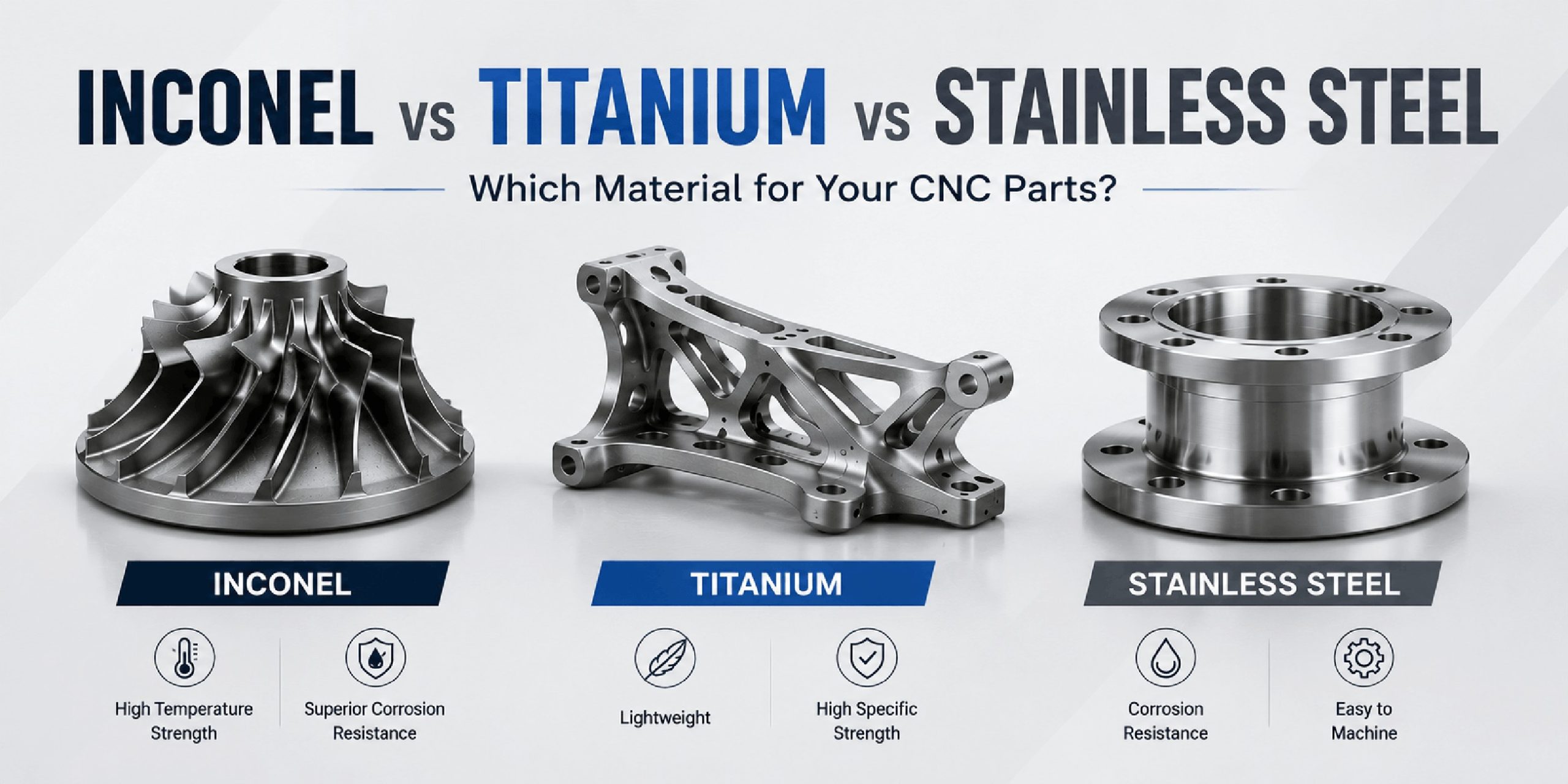
When selecting materials for high-temperature or corrosive environments, engineers often face the final choice between Inconel, titanium, and stainless steel. Titanium alloys meet weight reduction requirements but cannot sustain high-temperature strength over the long term; stainless steel offers controllable costs but struggles to withstand environmental corrosion and creep; Inconel provides comprehensive performance, but its machining difficulty and cost present challenges.
The trade-off between performance, cost, and weight is a common challenge for engineers when selecting materials. This article examines and compares the performance, machining costs, and application limits of these three materials from a CNC machining perspective, providing a reference for material selection under similar operating conditions.
Quick View
| Material | Inconel (e.g., 718) | Titanium (e.g., Ti-6Al-4V) | Stainless Steel (e.g., 316L) |
|---|---|---|---|
|
Maximum operating temperature (°C) |
700–1000 |
400–600 |
300–400 |
|
Density (g/cm³) |
8.19 |
4.43 |
7.98 |
|
Tensile Strength at Room Temperature (MPa) |
1200–1400 |
900–1000 |
480–620 |
|
Corrosion Resistance |
High |
Good |
Fair |
|
CNC Machining Difficulty |
Extremely difficult; machining causes rapid tool wear and elevated cutting temperatures, requiring specialized tools and processes |
Moderately difficult; poor thermal conductivity leads to heat buildup, requiring low cutting temperatures and adequate cooling |
Moderate; 316L is easy to machine but tends to stick to the tool |
|
Raw Material Cost Multiplier (with 316L as 1×) |
3.5–5× |
2–3× |
1× |
|
Machining cost multiplier (with 316L as 1×) |
3–4× |
2–2.5× |
1× |
|
Typical applications |
Aviation engine turbine blades, combustion chambers, nuclear reactor components |
Aerospace structural components, racing car parts, marine corrosion-resistant parts |
Chemical process piping, medical devices, general machinery parts |
Data sources: ASM, Special Metals, and general industry practices in the CNC machining sector
Understanding the Material
What is inconel?
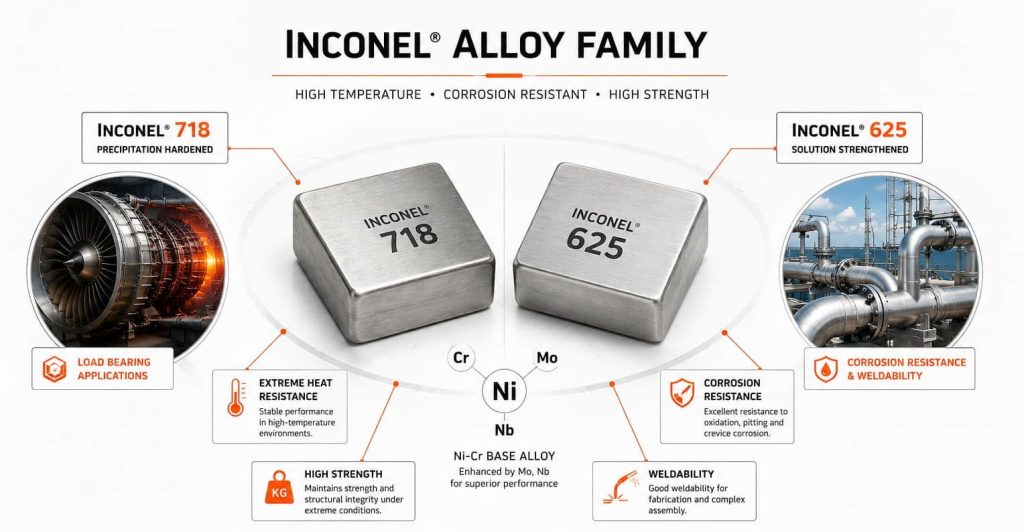
Inconel is a nickel-chromium-based high-temperature alloy characterized by high-temperature resistance, corrosion resistance, and high strength, particularly maintaining stable performance in environments with extreme temperatures and severe corrosion. The most common grades are Inconel 718 (which achieves high strength through precipitation hardening and is designed for structural load-bearing applications) and Inconel 625 (which is solution-strengthened with molybdenum and niobium and is designed for corrosion resistance and weldability).
What is stainless steel?
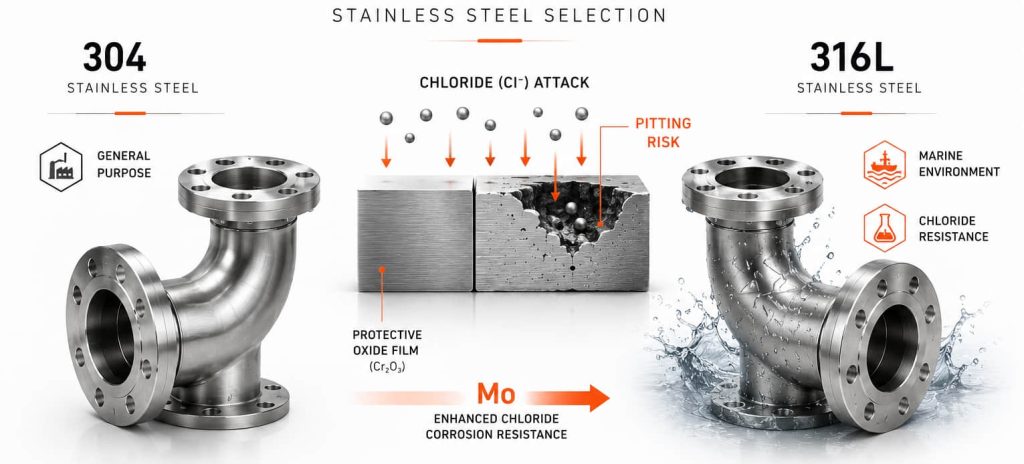
Stainless steel is an iron-based, chromium-containing corrosion-resistant alloy. Its core characteristics are corrosion resistance and cost-effectiveness, particularly in maintaining stable performance under conventional corrosion conditions and in low-to-medium temperature environments.
However, it is worth noting that stainless steel’s corrosion resistance has clear limitations: it is prone to pitting corrosion in high chloride environments (such as seawater), and its strength decreases significantly above 300°C. This is a common pitfall for engineers when selecting materials; they often default to 316L but overlook its temperature and corrosion limits. The most common grades are the general-purpose 304 and 316L, which offers greater resistance to chloride corrosion.
What is Titanium?
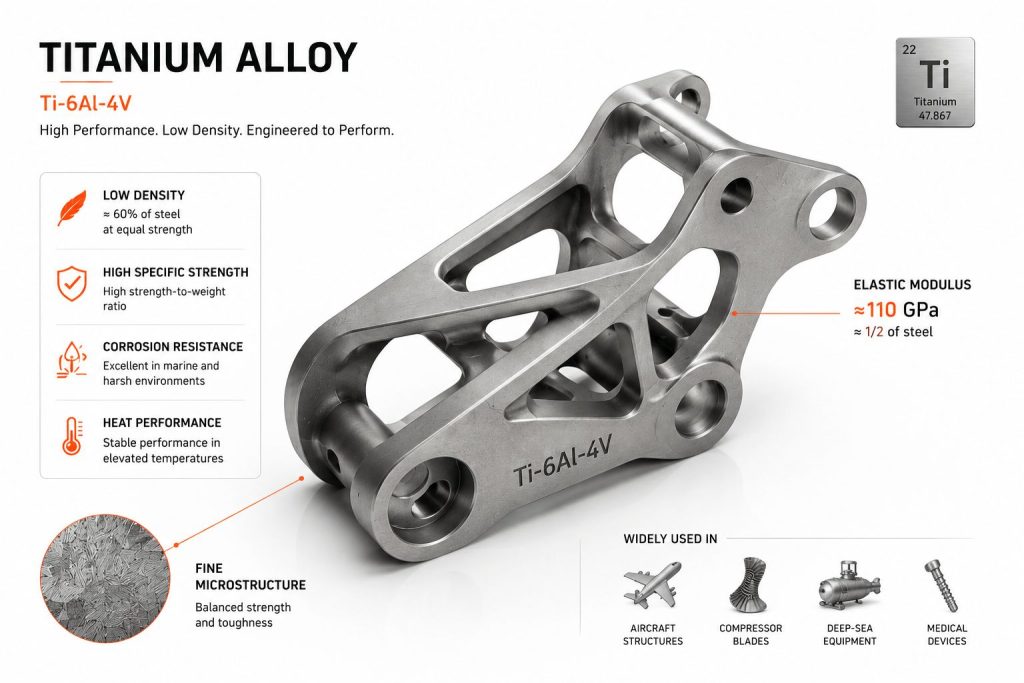
Titanium is an alloy material based on titanium, combined with other elements such as aluminum, vanadium, and molybdenum. Its core advantage is high specific strength (weighing approximately 60% of stainless steel for the same strength), but one often-overlooked drawback must be noted: the elastic modulus of titanium alloys is only about half that of steel (~110 GPa vs. ~200 GPa), meaning greater deformation under the same load. For structural components requiring high rigidity, choosing titanium may actually result in excessive deflection. Titanium alloys are widely used in aircraft structural components, aircraft compressor blades, deep-sea equipment, and other applications, with Ti-6Al-4V being the most common grade.
Titanium vs Inconel vs Stainless Steel: Key Differences
High-Temperature Performance
Among these three materials, the high-temperature resistance ranks from highest to lowest as follows: Inconel > Titanium > Stainless Steel
- Inconel alloys offer excellent high-temperature stability and oxidation resistance, maintaining high strength over extended periods at temperatures ranging from 650°C to 1000°C or even higher. Inconel 718 has a long-term service limit of approximately 700°C, while Inconel 625 can withstand even higher temperatures.
- Next is titanium alloy, which has a long-term service limit of approximately 400°C and can withstand short-term temperatures up to 600°C, offering moderate high-temperature resistance;
- Stainless steel has the lowest heat resistance; its strength drops significantly above 300°C, making it suitable only for ambient to low-to-medium temperature conditions.
Material Selection Recommendations: If your parts operate at temperatures below 300°C for extended periods, all three materials are suitable; prioritize stainless steel to control costs. For the 300–400°C range, exclude stainless steel and evaluate whether titanium alloys meet the requirements; for temperatures above 400°C, prioritize Inconel; for temperatures above 600°C, there are no other options.
Corrosion Resistance Comparison
Among the three materials, the overall ranking of corrosion resistance from strongest to weakest is: Titanium > Inconel > Stainless Steel; However, the results may be reversed in different corrosive environments.
1.Room-temperature seawater/chloride environments: Titanium alloys > Inconel > Stainless steel
Titanium alloys form a dense oxide film and are virtually immune to chloride ion attack, making them the preferred choice for seawater applications; Inconel, containing elements such as nickel and chromium, exhibits significantly better resistance to chloride corrosion than ordinary stainless steel; stainless steel (including 316L) remains susceptible to pitting corrosion after prolonged immersion in seawater.
2.High-temperature oxidative environments: Inconel > Titanium Alloys > Stainless Steel
Due to its high chromium and aluminum content, Inconel forms a continuous, dense oxide film. In extreme high-temperature environments ranging from 600°C to 1000°C, it offers the best oxidation resistance and resistance to scaling, making it the only reliable choice for such conditions; Titanium alloys exhibit excellent oxidation resistance at ambient temperatures below 400°C and in marine environments, but the oxidation rate begins to increase significantly above 400°C; stainless steel provides only basic oxidation resistance in conventional environments below 300°C. Above 300°C, both its strength and oxidation resistance decline rapidly, making it completely unsuitable for high-temperature applications.
3.Strongly Reducing Acids (Dilute Sulfuric Acid, Hydrochloric Acid): Titanium Alloys > Inconel > Stainless Steel
Titanium alloys exhibit good corrosion resistance in dilute sulfuric acid and dilute hydrochloric acid; however, it is important to note that titanium alloys are rapidly corroded by hydrofluoric acid. Inconel performs averagely in reducing acids, while stainless steel is generally not corrosion-resistant in reducing acids.
4.Oxidizing acids (e.g., concentrated nitric acid, hot concentrated sulfuric acid): Stainless steel ≈ Inconel > Titanium alloys
Both stainless steel and Inconel rely on the stability of their oxide films and perform well in oxidizing acids such as concentrated nitric acid; titanium alloys may undergo violent reactions in concentrated nitric acid and should be selected with caution.
Material Selection Recommendations: Titanium alloys are the first choice for seawater or chloride environments; Inconel is the first choice for high-temperature oxidizing environments (above 600°C); both titanium alloys and Inconel are suitable for reducing acid environments, but hydrofluoric acid applications must be excluded; in standard atmospheric environments, stainless steel is sufficient, and there is no need to spend extra money.
Weight vs. Performance Trade-Off
When selecting materials, it is not enough to consider density or strength in isolation; what engineers really need to compare is the strength-to-weight ratio—which material can withstand a greater load for the same weight. The difference in strength-to-weight ratio among the three materials is striking: Ti-6Al-4V has a strength-to-weight ratio approximately three times that of 316L stainless steel. This means that, while meeting the same strength requirements, titanium alloy parts weigh only about one-third as much as stainless steel parts. This is the core reason why titanium alloys are irreplaceable in aerospace structural components. Inconel has the highest absolute strength but also the highest density (8.19 g/cm³), so its strength-to-weight ratio is not particularly outstanding. Its value lies in maintaining strength at high temperatures, rather than in weight reduction.
However, specific strength is not the only metric. The elastic modulus of titanium alloys is only about half that of steel (~110 GPa vs. ~200 GPa), resulting in nearly double the deformation under the same load. If your part has strict stiffness requirements—such as precision fixtures, machine tool structural components, or optical platform mounts—selecting a titanium alloy may actually lead to excessive deflection, even if the strength is entirely sufficient.
Material Selection Recommendation: First, determine whether the design bottleneck is strength or stiffness. If strength is the limiting factor and weight reduction is required (e.g., aerospace structural components, racing car parts), titanium alloys offer the greatest advantage; if stiffness is the limiting factor (e.g., precision equipment, machine tool components), stainless steel or Inconel is more suitable; if neither weight reduction nor extreme strength is required, stainless steel offers the best cost-performance ratio.
Machinability Comparison
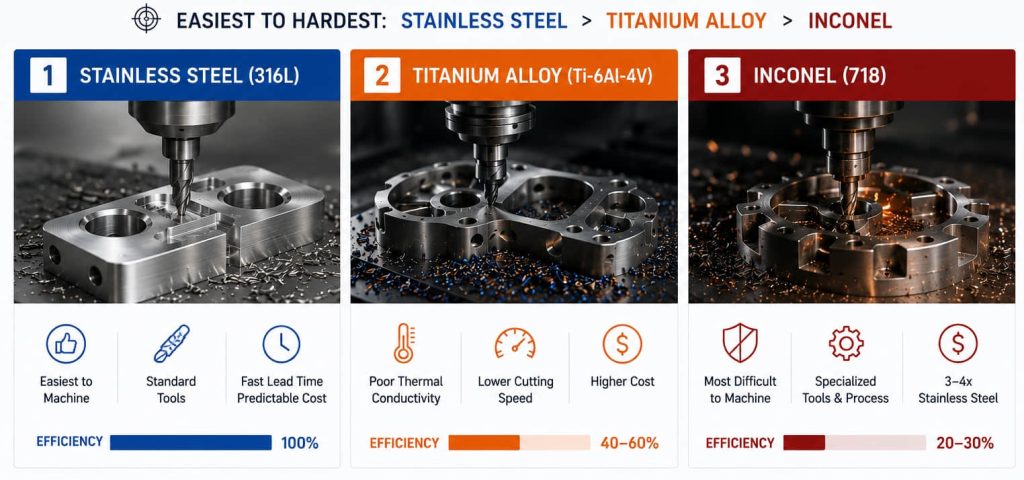
Among the three materials, machinability ranges from easiest to hardest as follows: stainless steel > titanium alloy > Inconel.
Stainless steel (316L) is the easiest to machine of the three; standard carbide tools are sufficient, and most CNC machining shops can handle the work, offering the most predictable lead times and pricing.
Titanium alloys have poor thermal conductivity, making them prone to tool sticking and accelerated tool wear. Machining requires reduced cutting speeds, resulting in an efficiency of approximately 40–60% that of stainless steel. Most experienced machining shops can handle this, but quotes will be significantly higher than for stainless steel parts of the same size.
Inconel (using 718 as an example) is the most difficult material to machine among the three. It is highly hard and prone to work hardening, requiring specialized tools and custom processes. The number of suppliers capable of consistently machining Inconel is limited; quotes are typically 3–4 times higher than for stainless steel, lead times are longer, and there are even instances where machining shops refuse orders due to the high risk involved.
Material Selection Recommendations: If project deadlines are tight or budgets are limited, prioritize the possibility of using stainless steel as a substitute. If titanium alloys or Inconel are essential, confirm tooling solutions and expected lead times with suppliers during the quotation phase to avoid discovering cost overruns once production has begun.
Cost Comparison: Material Cost vs. Machining Cost
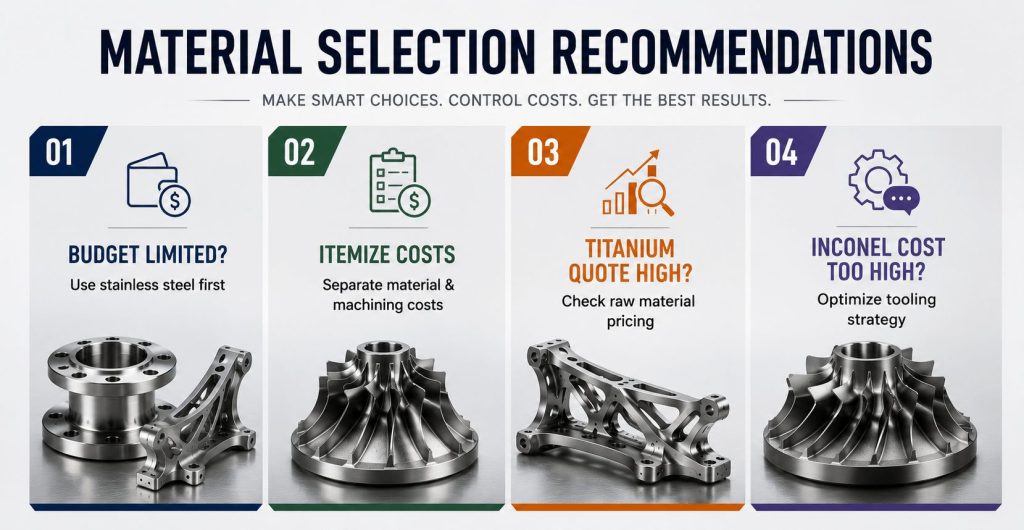
Among the three materials, the raw material and machining costs rank from highest to lowest as follows: Inconel > Titanium Alloy > Stainless Steel
Stainless steel (using 316L as an example) is the least expensive of the three. Its raw material cost is at the benchmark level, with transparent pricing and ample market supply. Machining costs are also the lowest; standard carbide tools can be used for machining, resulting in high machining efficiency and low tool wear.
Titanium alloy (using Ti-6Al-4V as an example) falls in the middle range in terms of cost. Raw material costs are 2–3 times those of stainless steel. Prices are highly influenced by demand in high-end aerospace applications and thus exhibit relatively significant fluctuations. Machining costs are 2–2.5 times those of stainless steel. Due to poor thermal conductivity, cutting speeds must be reduced and tools frequently changed, resulting in a noticeable increase in labor and tooling costs
Inconel (using 718 as an example) is the most expensive of the three materials. Raw material costs are 3.5–5 times those of stainless steel; due to the high proportion of precious metals like nickel and chromium, prices remain consistently high. Machining costs are 3–4 times those of stainless steel. High cutting resistance requires specialized tools, resulting in longer processing times and extremely high tool wear costs.
Material Selection Recommendations: When budgets are limited, prioritize using stainless steel as a substitute for titanium alloys or Inconel. It is recommended to request that suppliers itemize material costs and machining costs separately during the quotation phase. If the quotation for titanium alloys is unreasonably high, first verify whether it is due to fluctuations in raw material market prices. If the machining cost accounts for an excessively high proportion of the Inconel quotation, discuss with the supplier whether there are more efficient tooling solutions or process routes to reduce machining costs.
Comparison of Common Grades
There are significant differences in performance details among different grades. The table below summarizes the most representative grades, key properties, and typical applications for each of the three materials, making it easy to compare and select the appropriate material:
| Material Category | Representative Grade | Key Properties | Recommended Applications | Why Choose This |
|---|---|---|---|---|
|
Inconel |
Inconel 718 |
Precipitation-hardening, high strength and fatigue resistance at -253–700°C |
Suitable for high-temperature structural applications (≤700°C) |
Among Inconel grades, 718 offers the highest strength |
|
|
Inconel 625 |
Molybdenum-niobium strengthened, highly corrosion-resistant, excellent weldability |
Suitable for highly corrosive environments (≤650°C) |
Emphasizes corrosion resistance and weldability; no precipitation hardening required |
|
|
Inconel 600 |
Solution-hardened, resistant to high-temperature oxidation and carburization |
Suitable for high-temperature oxidation/carburization environments (≤1100°C) |
Niobium-free, with outstanding high-temperature oxidation resistance |
|
Titanium Alloys |
Ti-6Al-4V |
α+β phase, high strength, corrosion resistance, lightweight |
Suitable for medium-temperature lightweight structures (≤400°C) |
Optimal balance of strength, ductility, and machinability |
|
|
Ti-6Al-2.5Mo-2Cr |
Good strength at medium to high temperatures, excellent thermal stability |
Suitable for medium to high-temperature aerospace components (≤500°C) |
Significantly improved high-temperature strength and thermal stability compared to Ti-6Al-4V |
|
|
TA1 / TA2 |
Pure titanium, good ductility, excellent corrosion resistance, lower strength |
Suitable for highly corrosive, low-load applications (≤300°C) |
Superior corrosion resistance to titanium alloys, good ductility and easy to form |
|
Stainless Steel |
304 |
Austenitic, general corrosion resistance, easy to machine, high cost-effectiveness |
Suitable for general corrosion at room temperature (≤300°C) |
Balanced overall performance, low cost, and easy to source |
|
|
316 |
Contains molybdenum, resistant to chloride ion corrosion, |
Suitable for chloride ion corrosion environments (≤300°C) |
Molybdenum content enhances resistance to chloride ion corrosion |
How to Choose the Right Material
The core of material selection for engineers is to start with the constraints and systematically eliminate options, thereby quickly identifying the optimal solution:
1.First, consider the operating temperature
- Above 600°C: Only Inconel is suitable
- 400–600°C: Stainless steel is out of the running; evaluate whether titanium alloys can withstand short-term exposure to these temperatures; if not, choose Inconel
- 300–400°C: Exclude stainless steel; titanium alloys are suitable
- Below 300°C: All three materials are viable; proceed to the next step
2. Next, consider the corrosion environment
- Chloride/seawater environments: Titanium alloys are the preferred choice
- Reducing acids (dilute sulfuric acid, hydrochloric acid): Titanium alloy or Inconel, but hydrofluoric acid applications must be excluded
- Standard atmospheric environments: Stainless steel is sufficient
3.Finally, consider weight reduction and budget
- If extreme weight reduction is required: Prioritize titanium alloy;
- If there are no special weight reduction requirements and the budget is limited, stainless steel is the most cost-effective general-purpose choice.
Conclusion
Inconel, titanium alloys, and stainless steel are three common high-performance metals used in CNC part manufacturing, each with its own distinct characteristics. Choose Inconel for high-temperature or highly oxidizing environments; opt for titanium alloys when seawater corrosion resistance or weight reduction is a priority; and select stainless steel for mild operating conditions and limited budgets. For engineers, there is no single “best” material. Only by making a rational selection based on operating conditions, corrosion resistance, and budget can the optimal balance between performance, feasibility, and cost-effectiveness be achieved.
xmake offers professional CNC machining services, providing customized solutions—from material selection to mass production—tailored to a part’s operating temperature, corrosive environment, and structural complexity. We machine common grades such as Ti-6Al-4V, 304, and 316L, and can accommodate high-tolerance customization based on your drawings. Please contact the xmake.com engineering team—we offer free technical consultations, and you can receive a quote within 24 hours by uploading your drawings.
FAQ
Q1: Is Inconel stronger than titanium?
A: At room temperature, titanium alloys have higher strength than Inconel for the same weight; at moderate temperatures (200°C to 500°C), their strengths are roughly equal; and in the high-temperature range (500°C to 1000°C+), Inconel’s high-temperature strength and thermal stability far exceed those of titanium alloys. In short, Inconel should be the first choice for high-temperature applications, while applications at medium and low temperatures require a case-by-case analysis.
Q2: Is Inconel or titanium more expensive?
A: Inconel is more expensive than titanium alloys. Inconel contains a higher proportion of precious metals such as nickel and chromium, and is more difficult to process. Generally, standard industrial-grade Inconel costs approximately $21–$35/kg, while titanium alloys cost approximately $17–$28/kg. High-end aerospace-grade Inconel costs 1.5 to 2 times as much as titanium alloys.
Q3:What is the difference between Inconel and stainless steel?
A: Inconel far surpasses stainless steel in terms of strength, high-temperature resistance, and corrosion resistance, making it suitable for extreme high-temperature conditions; stainless steel offers better value for money, has a wider range of applications in general-purpose scenarios at room temperature, and is less expensive than Inconel.
Q4: When should I use Monel instead of Inconel?
A: Monel is more suitable for highly reducing corrosive environments such as seawater, high-chloride solutions, hydrofluoric acid, and concentrated alkalis, provided the temperature does not exceed 480°C and extreme high-temperature strength is not required; whereas Inconel should be the first choice for high-temperature conditions (requiring high-temperature strength at approximately 600°C or higher) and oxidizing environments
Q5: Is Inconel more heat-resistant than stainless steel?
A: Yes. Under sustained high temperatures (above approximately 600°C), Inconel can maintain high strength and oxidation resistance, whereas stainless steel softens at the same temperatures, causing its performance to deteriorate rapidly.
Q6:What makes Inconel resistant to high temperatures?
A: Inconel’s high-temperature resistance stems from two factors: its alloy composition contains elements such as nickel, chromium, and molybdenum, which not only maintain the material’s matrix strength at high temperatures but also form a dense oxide protective layer on the surface to prevent further oxidation and corrosion. Consequently, it can operate stably for extended periods in extreme environments above 600°C.