
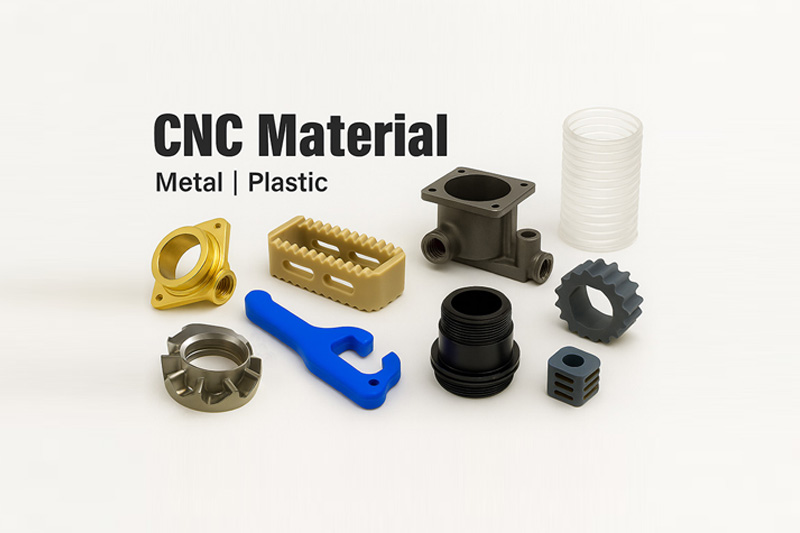
Introduction: CNC machining supports a wide range of materials, including various metals and engineering plastics. Each material differs significantly in performance, machinability, and cost, making it suitable for different application scenarios. This article outlines the most common CNC materials and summarizes their key characteristics to help you identify the best option for your project.
Common CNC Materials
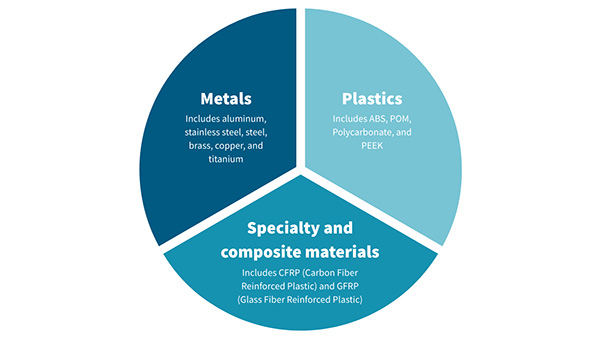
CNC materials primarily fall into three categories: metals, engineering plastics, and composites. This article focuses on the first two—metals and plastics. Metals are the core system of CNC machining, including aluminum, stainless steel, brass, pure copper, carbon steel, alloy steel, titanium alloys, etc. Plastics include POM, Nylon, PC, ABS, PMMA, PEEK, etc. Different materials vary significantly in strength, machinability, dimensional stability, cost, etc, making them suitable for different part scenarios. This chapter systematically introduces their key characteristics to help you quickly determine the most suitable CNC machining material.
I.Metal
Aluminum
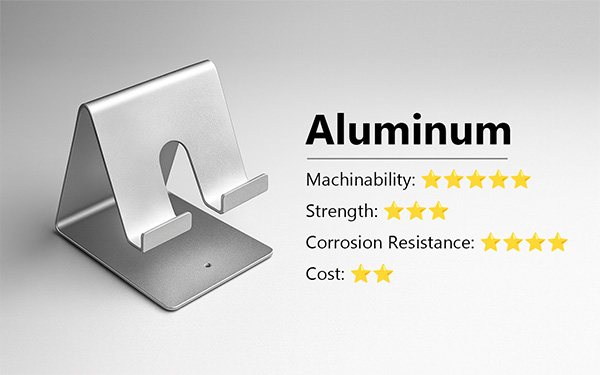
Aluminum features low density, high specific strength, excellent machinability, and relatively low cost, making it one of the most widely used metal materials in CNC machining.
Specifically, aluminum is only one-third the density of steel, but provides the strength to meet the needs of most structures, particularly high-strength aluminum alloys such as 7075, which approach the performance of some medium-grade steels. Aluminum also has good corrosion resistance, with a dense oxide film naturally forming on its surface, making it stable over time in air and lightly corrosive environments. In addition, aluminum has excellent electrical and thermal conductivity.
For machining, aluminum is highly stable in the cutting process. The material is soft and uniformly organized, which makes it less prone to hardening and tool sticking during machining, supporting high-speed, high-efficiency CNC milling and turning while maintaining low tool wear.
In terms of cost, aluminum machining is highly economical: its raw material price is lower than most metal, and its high cutting efficiency keeps machining costs down. This makes aluminum one of the most cost-effective metal materials for CNC machining.
Common models: 6061-T6、6082-T6、7075-T6
Brass
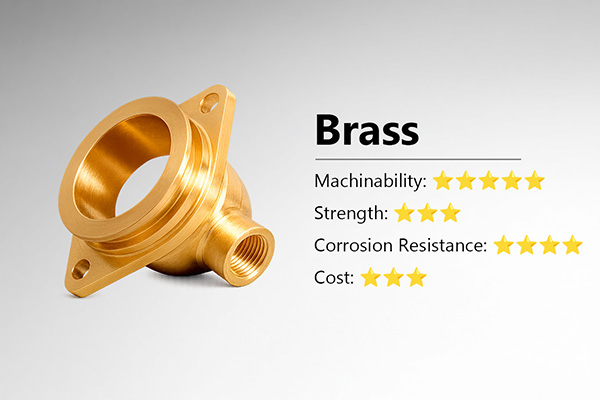
Brass is an alloy primarily composed of copper and zinc, widely used in precision manufacturing due to its exceptional workability and excellent thermal and electrical conductivity. With high thermal conductivity and good electrical conductivity, brass is a common material for functional components such as heat dissipation structures and electrical connectors. Additionally, it maintains stable corrosion resistance in air, water, and most neutral media, resisting rust formation. This makes it suitable for general outdoor environments or structural components exposed to fluids.
In terms of machining, brass has low cutting resistance, good chip breaking properties, and is not prone to hardening or tool sticking, making it particularly suitable for high-speed turning and milling. Brass also offers dimensional stability and excellent formability, making it suitable for processes such as stamping and bending. While brass is more expensive than aluminum and steel, its extremely high machining efficiency keeps its overall manufacturing cost competitive.
Commonly Brass Types: Free-Cutting Brass (e.g., C3604, C3602)、High-Ductility Brass (e.g., C2680)、General-Purpose Brass (e.g., C2801)
Pure Copper
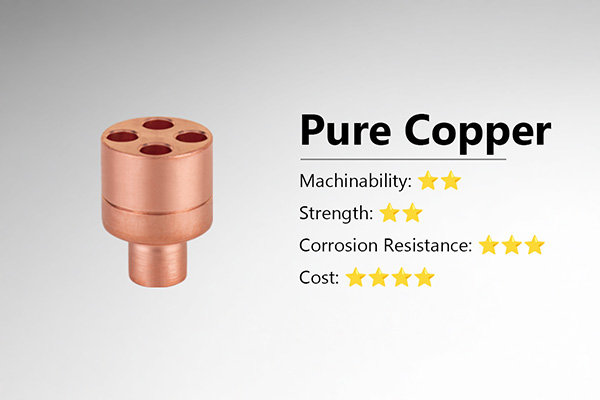
Pure copper consists primarily of high-purity copper. Its greatest advantage lies in its exceptionally high electrical and thermal conductivity. Additionally, pure copper exhibits outstanding ductility and formability, enabling it to undergo various plastic forming processes such as bending, stamping, and drawing with ease. Surface oxidation is another characteristic of pure copper, forming a brown or dark oxide layer. To maintain a bright finish, it requires subsequent electroplating or coating treatments.
During machining, pure copper cuts smoothly and doesn’t easily work-harden, but its softness makes it prone to tool sticking, which actually makes it more challenging to machine overall.
In terms of cost, pure copper is significantly more expensive than aluminum and carbon steel, and its higher machining difficulty also leads to increased processing costs. Therefore, unless a part truly requires exceptional electrical or thermal conductivity, brass is often chosen instead.
Common Grades: C101、C103
Carbon Steel
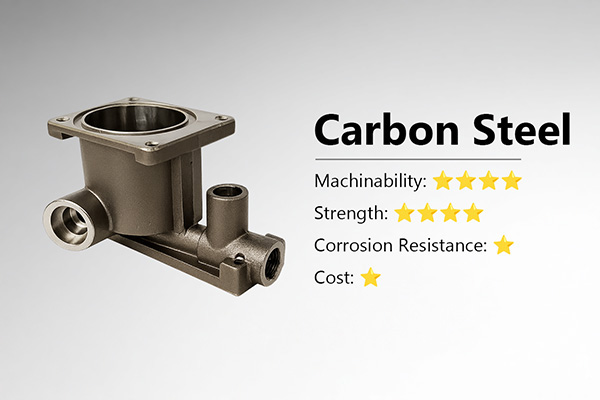
Carbon steel is an alloy material primarily composed of iron and carbon. Based on varying carbon content, it can be classified into low-carbon steel, medium-carbon steel, and high-carbon steel. Carbon steel generally possesses higher strength than aluminum and copper, with excellent rigidity that enables it to withstand heavy loads. Consequently, it serves as the primary material for structural components and mechanical support parts. However, carbon steel lacks inherent corrosion resistance and will rust when exposed to moisture or air, so it often requires surface treatment.
In terms of machining, carbon steel offers excellent overall workability, being easy to machine, weld, and heat treat. Higher hardness and wear resistance can be achieved through processes such as quenching and tempering. Combined with its relatively low material cost, carbon steel is widely used in mass-production applications.
Common steel types: Low carbon steel (1018, 1020, Q235):、Medium carbon steel (1045 (C45), 40Cr)、High carbon steel (1095, SK5)
Alloy Steel
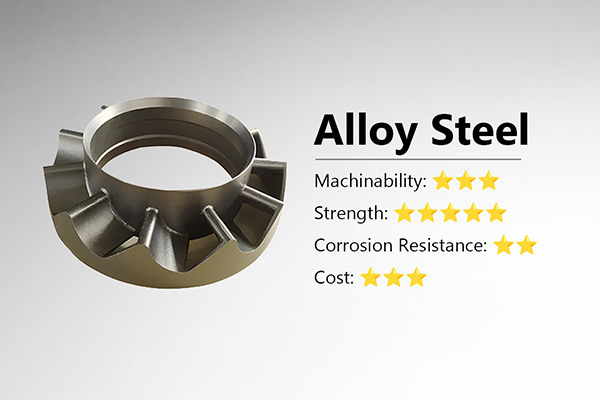
Alloy steel is essentially carbon steel enhanced with additional alloying elements—such as chromium, nickel, and molybdenum—to achieve higher strength, toughness, wear resistance, and overall improved performance.Alloy steel performance falls between carbon steel and tool steel, and like carbon steel, its mechanical properties depend heavily on heat treatment. In addition, alloy steel has only moderate corrosion resistance (slightly better than carbon steel), so it typically requires additional surface finishing.
During machining, alloy steel generates higher cutting resistance, making it more difficult to machine and more expensive than standard carbon steel. In terms of cost, alloy steel itself is more expensive, and when factoring in lower machining efficiency, higher tool wear, and the need for precise heat treatment, the overall manufacturing cost increases even further.
Common grades: 4140 steel 、4340 steel
Stainless teel
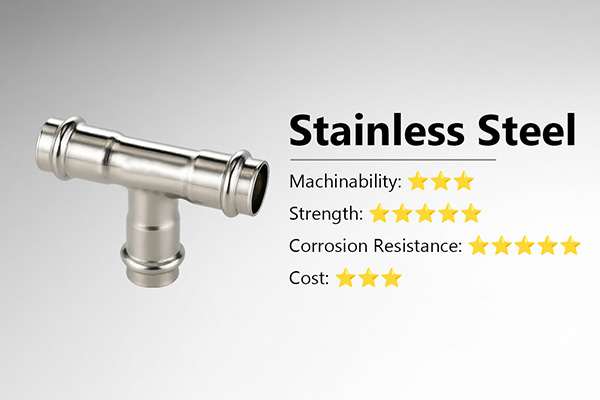
Stainless steel is a type of iron-based alloy material with high strength, good toughness, and excellent corrosion resistance. Its greatest advantage lies in the high corrosion resistance provided by the chromium passivation film on its surface, allowing it to remain rust-free and uncorroded for extended periods in various environments. At the same time, stainless steel has significantly higher strength than aluminum and copper alloys, possesses good toughness, and is not easily broken or deformed, making it ideal for manufacturing load-bearing, stress-bearing, or durable structural parts.
However, due to its high strength and the tendency to harden during processing, stainless steel is far more difficult to cut than other metals. In terms of cost, the raw material price of stainless steel is generally higher than that of carbon steel and some aluminum alloys, and its processing costs are also higher.
Common Grades: 303、304 / 304L、316 / 316L、17-4PH:、420 / 440C.
Magnesium Alloys
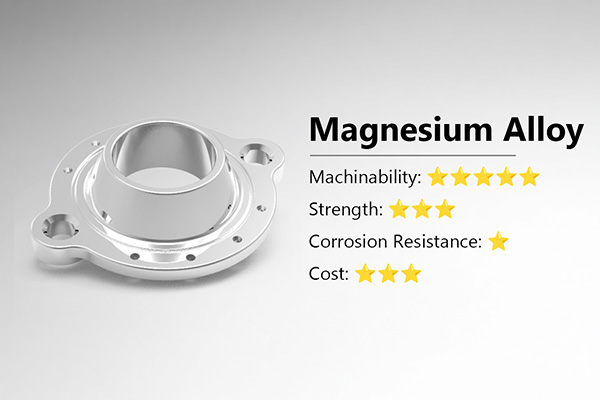
Magnesium alloys are metal materials based on magnesium and alloyed with elements such as aluminum, zinc, and manganese. Magnesium alloys are among the lightest structural metals available, with a density roughly two-thirds that of aluminum and only one-quarter that of steel. Combined with excellent thermal conductivity and vibration-damping properties, magnesium alloys are ideal for lightweight and heat-dissipating components.
In terms of machining, magnesium alloys are soft, have very low cutting resistance, and offer high CNC machining efficiency with minimal tool wear. Their main drawback is poor corrosion resistance, so surface treatment is usually required. As for cost, raw material prices are slightly higher than aluminum, but the lighter cutting load makes machining cheaper, giving magnesium alloys a strong overall cost-performance advantage among lightweight materials.
Common Grades:AZ91、AZ31、AM60.
Inconel
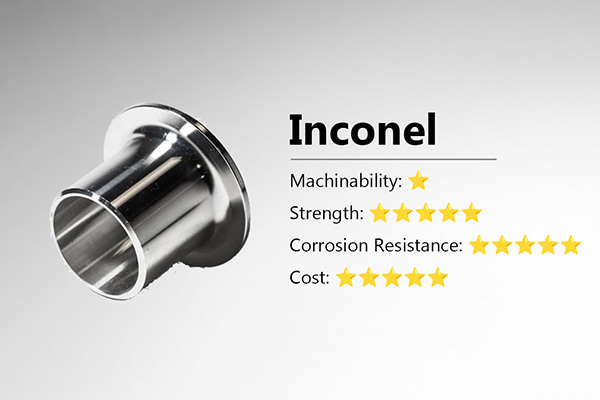
Inconel is a family of nickel-based superalloys containing elements such as chromium, iron, molybdenum, and niobium. Its biggest advantage is its exceptional high-temperature strength and outstanding oxidation and corrosion resistance, allowing it to maintain structural stability even under extremely harsh conditions—typically between 700°C and 900°C, or even higher. This makes Inconel a go-to material for aerospace, energy, and chemical applications.
From a machining perspective, Inconel is difficult to work with. It generates very high cutting forces, tends to work-harden quickly, and is prone to tool adhesion, all of which significantly reduce machining efficiency. Combined with its high nickel content, both the raw material cost and machining cost are much higher than stainless steel or aluminum. As a result, Inconel is generally reserved for parts that require extreme heat resistance or corrosion resistance.
Common Grades:Inconel 718、Inconel 625、Inconel 600 / 601.
II.Plastic
POM
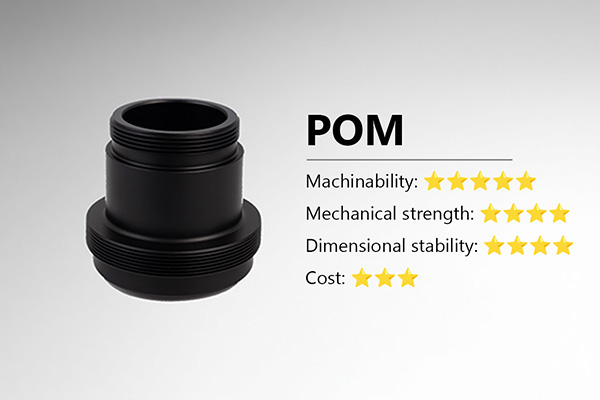
POM (Polymer Oxide) is an engineering plastic with properties close to those of metals, renowned for its high rigidity, high strength, and excellent wear resistance, often referred to as “acetal”. POM has a low coefficient of friction and excellent sliding properties, making it suitable for parts requiring long-term movement or subjected to friction, such as gears, sliders, and bushings. Due to its extremely low water absorption, POM exhibits excellent dimensional stability, maintaining precise geometry even in environments with varying humidity levels.
However, POM has limited heat resistance (approximately 80–100°C long-term) and is not resistant to strong acids and alkalis. It is prone to slow deformation under sustained stress, making it unsuitable for structural components subjected to long-term loads or in high-temperature environments. Furthermore, POM’s very smooth surface and strong chemical inertness make it difficult for adhesives and coatings to adhere, making it both difficult to bond and paint.
In terms of processing, POM has good machinability and produces a high-gloss surface finish after processing. In terms of cost, POM is a mid-range engineering plastic, more economical than metals, yet it offers good mechanical properties and durability.
Nylon
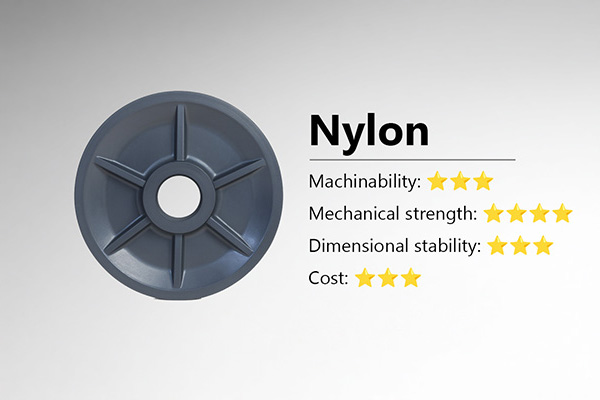
Nylon is a high-strength, tough, and wear-resistant engineering plastic, one of the most widely used structural materials in CNC machining. Its good load-bearing capacity and impact resistance make it suitable for structural components subjected to cyclic loads or impacts; while its excellent wear resistance and self-lubricating properties make it ideal for manufacturing gears, sliders, sliding fits, and other parts requiring repeated movement and continuous friction.
The main disadvantage of nylon is its relatively low dimensional stability. Due to its high water absorption rate, its dimensions may change slightly in humid environments, making it unsuitable for high-precision applications or applications exposed to prolonged moisture. Its weather resistance and UV resistance are also average, making it unsuitable for long-term outdoor exposure.
In terms of processing, nylon’s surface is relatively soft, making it prone to burrs during machining, thus requiring further processing after processing. In terms of cost, nylon is moderately priced, offers excellent overall performance, and provides high cost-effectiveness in structural applications.
Common grades: PA6, PA66, PA6-GF (glass fiber reinforced), PA66-GF (glass fiber reinforced).
ABS
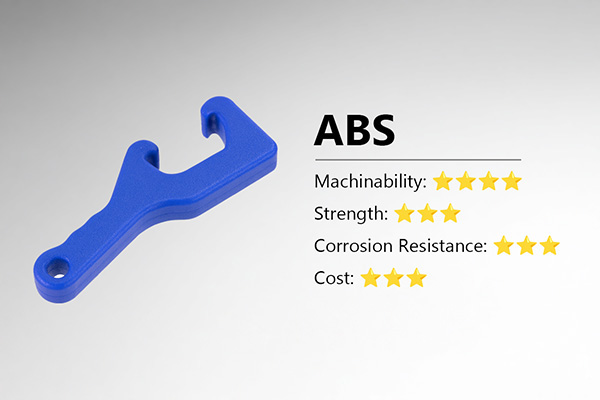
ABS is one of the most common plastic materials used in CNC machining, characterized by its lightweight, good toughness, and ease of processing. The material possesses moderate strength and good impact resistance, making it suitable for light to medium load-bearing structural parts. Its low water absorption and good dimensional stability make it ideal for manufacturing shell-type parts and structural components requiring precise appearance.
The main limitations of ABS are its moderate heat and weather resistance (long-term temperature resistance is approximately 70–90°C), which may cause deformation at high temperatures; it also has weak chemical resistance, making it unsuitable for contact with strong acids, alkalis, or high-solvent environments. Outdoor UV exposure accelerates aging, making it unsuitable for long-term outdoor use.
During processing, ABS cuts smoothly and is less prone to melting edges; in terms of cost, due to its very low material and processing costs, ABS still offers excellent cost-effectiveness in prototyping and low-to-medium load parts.
Common models: ABS, ABS+PC, Flame-retardant ABS (UL94 V-0).
PC
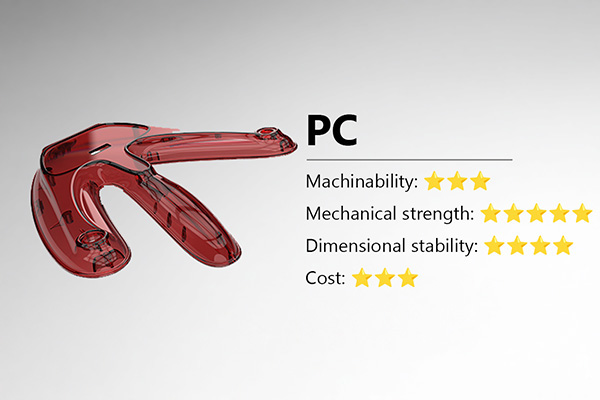
Polypropylene (PC) is an engineering plastic that combines high impact resistance, excellent transparency, and good heat resistance. In CNC machining, it is commonly used to manufacture functional structural parts and transparent exterior components. Its impact resistance is significantly better than PMMA and ABS, making it suitable for structures requiring impact or drop protection.
PC’s limitations mainly include poor surface scratch resistance, susceptibility to scratches, and moderate resistance to solvents such as alcohol and ketones; therefore, chemical contact should be avoided in the working environment.
During processing, PC exhibits stability, smooth cutting, and minimal deformation, meeting the requirements for manufacturing parts with high dimensional accuracy. However, PC is relatively hard, and stress marks can easily appear if machining parameters are not properly controlled. In terms of cost, PC is more expensive than general-purpose plastics such as ABS and PVC, but it remains in the mid-range price range compared to high-performance materials (such as PEEK).
PMMA
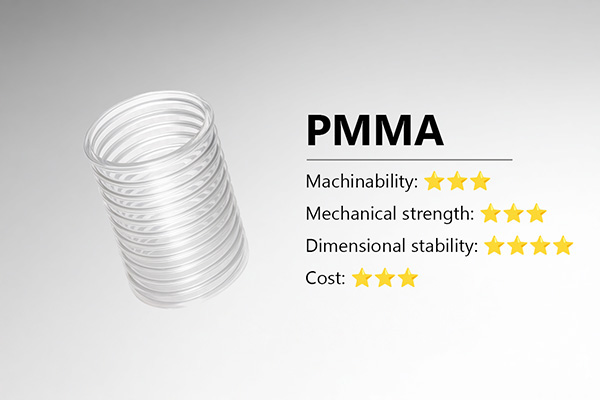
PMMA (acrylic, plexiglass) is an engineering plastic renowned for its high transparency and excellent weather resistance. Its light transmittance can reach 92%, yet it weighs only half that of glass, making it ideal as a material for transparent exterior parts in CNC machining. Furthermore, PC possesses excellent UV resistance and outdoor weather resistance, and it is not prone to yellowing or aging even after prolonged exposure to sunlight.
However, PMMA’s mechanical properties are relatively limited; its strength and impact resistance are weak, and the material itself is somewhat brittle. It is also sensitive to organic solvents such as alcohol and acetone, which can easily cause silver streaks or cracks upon contact. In addition, its heat resistance is average, with a continuous operating temperature of approximately 70–90°C, making it unsuitable for high-temperature or high-impact applications.
In terms of machining, PMMA offers a smooth cutting experience, good dimensional stability, and a high surface gloss can be achieved through polishing after machining. However, due to its inherent brittleness, special control of cutting forces and feed rates is required during machining to avoid edge chipping or micro-cracks. In terms of cost, PMMA is moderately priced, significantly lower than PC, making it a highly cost-effective material choice for applications requiring a transparent appearance, lightweight design, and good weather resistance.
Common types: Transparent PMMA, UV-resistant PMMA, Cast PMMA (better processability).
PEEK
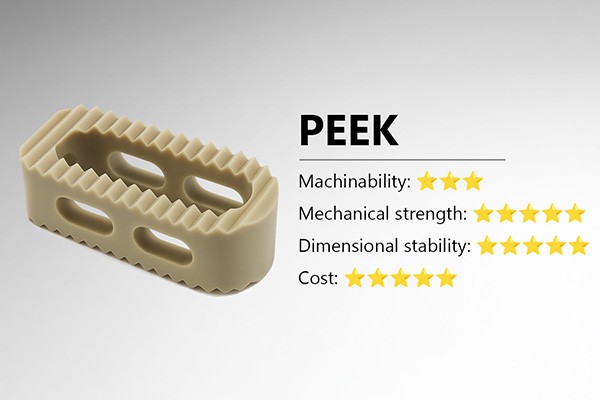
PEEK (Polyetheretherketone) is a high-performance specialty engineering plastic with excellent heat resistance, mechanical strength, and chemical stability. It can withstand long-term temperatures above 250°C, maintaining mechanical strength and structural stability even at high temperatures—a performance far exceeding that of other common engineering plastics. Furthermore, PEEK’s high strength, high rigidity, and excellent fatigue resistance make it an ideal material for manufacturing load-bearing structural components, precision mechanical parts, and high-wear components.
In terms of processing, PEEK is stable in cutting, but its high hardness and heat resistance place higher demands on cutting tools, making it more difficult to process than ordinary plastics. The main limitation of PEEK is its extremely high cost; the material price is far higher than most metals, and the processing difficulty is also greater than that of ordinary engineering plastics. Therefore, it is typically used in extreme environments or critical components, rather than for routine applications.
Common types: Pure PEEK, PEEK-GF (glass fiber reinforced), PEEK-CF (carbon fiber reinforced, high strength), medical-grade PEEK
How to Choose the Right CNC Material
Choosing the right CNC machining material isn’t complicated; the key is to determine the requirements of the part. It generally involves three steps:
The first step in selecting a CNC material is to understand the actual application scenario of the part—for example, whether it needs to bear loads, whether it is exposed to humid or high-temperature environments, etc. The application scenario directly determines the performance indicators that the material must possess, including strength, heat resistance, corrosion resistance, wear resistance, surface treatment compatibility, and accuracy stability. Once these key properties are clarified, the range of materials will naturally be narrowed.
After determining performance requirements, two to three candidate materials can usually be narrowed down. For example, aluminum alloys are preferred when lightweight and easy to process; carbon steel or stainless steel are preferred when high strength, rigidity, or wear resistance is required.
Finally,it is essential to strike a balance between performance and cost. Once the mechanical requirements and environmental conditions are defined, the best CNC material is the one that offers the optimal combination of material cost, machining cost, and overall performance.
FAQ
1. Which material has the highest strength?
In terms of absolute strength, Inconel and tool steel are the strongest metals among CNC materials; they maintain extremely high mechanical strength even after proper heat treatment or at high temperatures. While titanium alloys have slightly lower absolute strength than tool steel, their lower density results in the highest specific strength (strength/weight) among all metals, making them suitable for lightweight, high-strength structures.
Among plastics, PEEK has the highest strength and can be used in high-heat, high-load applications, making it the strongest performing engineering plastic.
2. Which material has the lowest cost?
Among CNC-machinable materials, carbon steel and ABS are the lowest-cost options—carbon steel being the most economical metal due to its low raw material price and moderate machinability, while ABS is the most affordable plastic thanks to its low material cost and easy processing.
3. If the product aims for lightweight design, which material should be selected?
For lightweight designs, aluminum alloys—especially 6061 and 7075—are the most common choice.
Aluminum has only one-third the density of steel while offering an excellent strength-to-weight ratio and great machinability, making it ideal for structural parts that need to stay light.
For ultra-lightweight requirements, engineering plastics such as POM, Nylon, PMMA, and ABS can also serve as structural materials for light-duty applications.
4. Which material is easier to machine?
Among all CNC-machinable materials, aluminum alloys and brass offer the best machinability:
- Aluminum (6061) machines exceptionally well — light cutting loads, good chip breaking, and low processing cost.
- Brass (e.g., C3604) is often called a “lathe-friendly material” due to its stable performance in high-speed turning and drilling.
- Among plastics, ABS and POM also provide excellent machinability.
Summary
This article provides a structured overview of commonly used CNC materials—both metals and engineering plastics—analyzing them across key factors such as strength, machinability, corrosion resistance, and cost.
During parts machining, material selection not only impacts part longevity and stability but also directly determines machining efficiency and overall costs. Selecting the right material ultimately comes down to finding the best balance between performance requirements, manufacturing feasibility, and budget.
We hope this guide will help you navigate the various materials available and find the most suitable solution for your project.
Xmake is a global manufacturing group providing customized manufacturing services, including 3D printing, CNC machining, sheet metal fabrication, injection molding, and vacuum casting. If you are still unsure about the appropriate materials, please contact us. We will provide more professional material selection advice based on structural requirements, material properties, and machining feasibility.